
Paper Ink Blog
Sticker vs. Printed Label: Which Does Your Saudi Business Need?

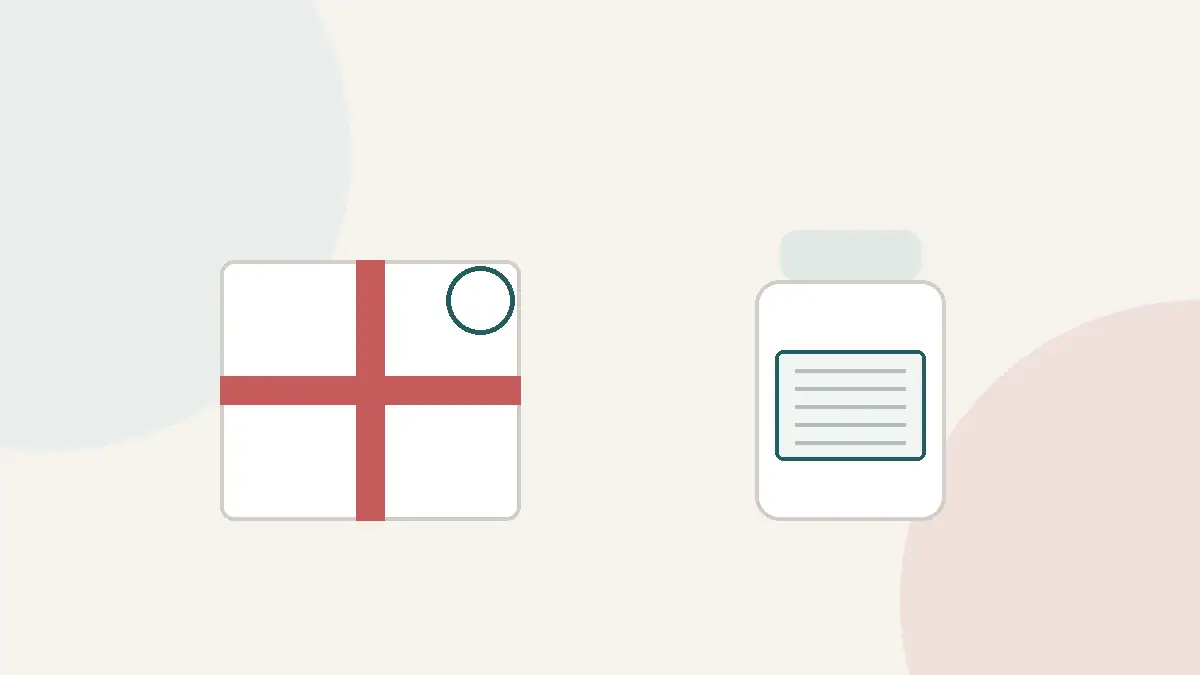
Short answer: use a sticker for branding and decoration, and a printed label for compliance, ingredients, or barcodes. A sticker’s job is to catch attention and promote your brand; a label’s job is to inform, identify, and meet regulatory requirements — and most growing Saudi businesses eventually need both, just for different products and different reasons.
Small business owners in Saudi Arabia often ask this question the moment they need to package a product for the first time — a skincare jar, a food item, a box of stickers for a boutique. The confusion is understandable: a sticker and a label can look identical on the roll, use the same vinyl or paper stock, and come off the same printer. The difference is in the job each one is designed to do.
What’s the Real Difference Between a Sticker and a Label?
A sticker is designed to promote, decorate, or build brand recognition. Think of a logo sticker on a gift box, a seal on packaging, or a promotional sticker handed out at an event.
A label is designed to inform, identify, or organize. Ingredient lists, barcodes, weight and expiry dates, and SFDA-required product information all belong on a label, not a decorative sticker.
The distinction matters because in Saudi Arabia, certain product categories — food, cosmetics, and health-adjacent items — have specific labeling obligations that a purely decorative sticker will not satisfy on its own.
When Should You Use a Sticker Instead of a Label?
Use a sticker when the goal is recognition, not information. Common cases for Saudi small businesses:
- Sealing a gift box or shipping carton with your logo
- Adding a decorative touch to packaging for boutiques, cafes, or events
- Branding giveaways, bags, or promotional items
- Reinforcing your name on a package that already carries a compliant product label elsewhere
If you’re looking for round, die-cut, and custom sticker options, this is exactly the use case they’re built for — fast turnaround, decorative finishes, and no compliance formatting required.
When Do You Actually Need a Compliant Product Label?
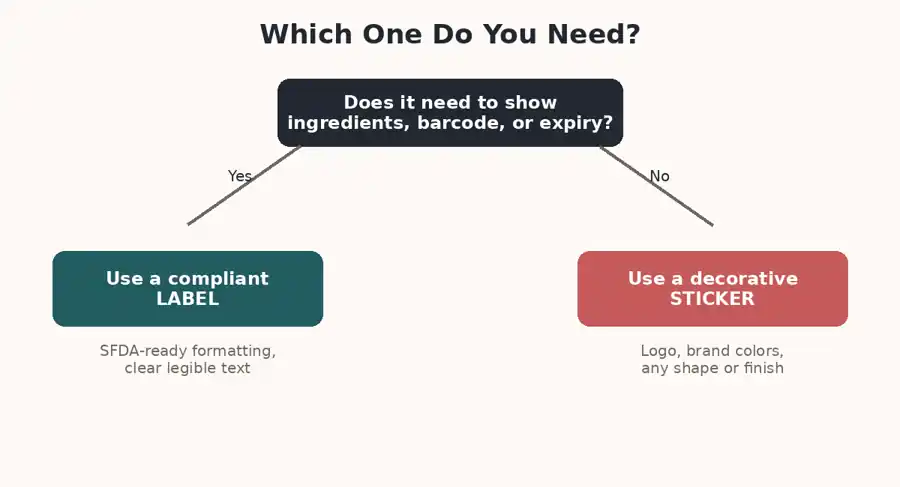
If your product is food, a cosmetic, a supplement, or anything with an expiry date or ingredient list, Saudi regulations require specific information to appear clearly on the packaging. This is where a label — not a sticker — is the correct tool.
Our guide on SFDA-compliant product label basics for small Saudi brands covers what information is typically expected on a compliant label before you send a design to print.
In short: if removing the artwork would remove information a customer or regulator legally needs to see, it’s a label. If removing it only removes branding, it’s a sticker.
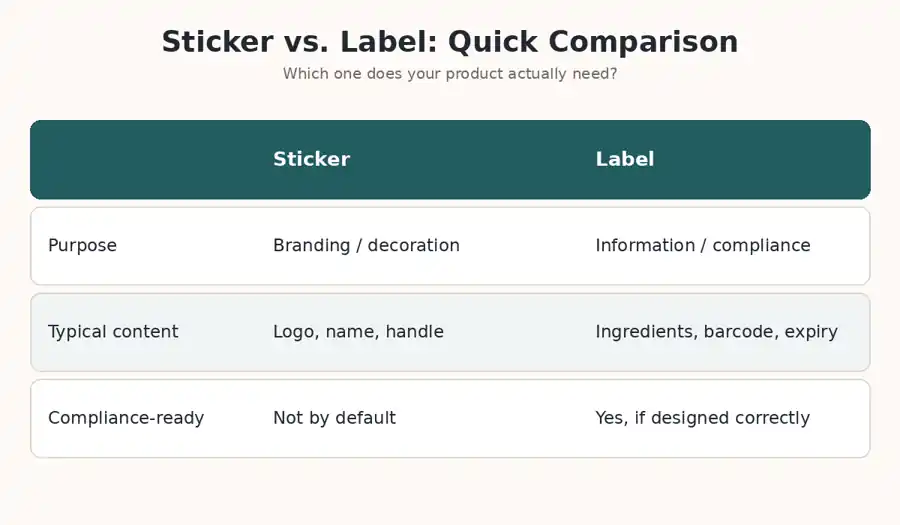
Sticker vs. Label: Quick Comparison
| Sticker | Label | |
|---|---|---|
| Main purpose | Branding, decoration, promotion | Information, identification, compliance |
| Typical content | Logo, name, social handle | Ingredients, barcode, weight, expiry |
| Compliance-ready | Not by default | Yes, when designed correctly |
| Common material | Vinyl, glossy, matte | Paper, vinyl, waterproof stock |
| Best for | Packaging, gifts, events | Food, cosmetics, retail products |
Can One Product Need Both?
Yes, and it’s common. A skincare jar might carry a compliant ingredient label on the back and a decorative brand sticker sealing the lid. A shipping box might have a barcode label for logistics and a branded sticker on the tape for recognition.
Treating these as two separate print jobs — instead of trying to force one sticker to do both jobs — keeps your packaging compliant and still lets your brand stand out.
Common Mistakes Saudi Sellers Make
Using a decorative sticker where a compliant label is legally required. This is the most common and costly mistake for food and cosmetic sellers — a beautiful sticker with no ingredient information does not meet SFDA expectations.
Printing labels only in Arabic or only in English. Many Saudi customers and regulators expect bilingual information; check our guide on bilingual Arabic-English product labels before finalizing your file.
Choosing material based on price alone. A cheap paper label on a product stored in a fridge or exposed to moisture will peel or blur within days.
Ordering a tiny trial batch every time. Reprinting small batches repeatedly usually costs more per piece than ordering a properly sized run once you know your packaging works. Our common sticker size guide can help you settle on dimensions before you order.
Checklist Before You Order
- Decided whether this specific product legally needs a compliant label, a decorative sticker, or both
- Checked what information must legally appear if it’s a food, cosmetic, or health-adjacent product
- Chosen a waterproof material if the product touches moisture, cold storage, or direct sunlight
- Confirmed whether the text needs to be bilingual (Arabic and English)
- Ordered a print quantity based on a full sales cycle, not a single trial batch
Frequently Asked Questions
Is a sticker cheaper than a label?
Not necessarily — price depends more on material, size, and quantity than on whether it’s called a sticker or a label. A simple decorative sticker can sometimes cost less because it skips the layout work needed for compliant information.
Can I legally use a sticker as my only product label?
If it contains all the required information (ingredients, weight, expiry, or barcode where applicable) and is applied correctly, a sticker can function as a label. The name matters less than whether the required content is present and legible.
What material should I choose if my product goes in the fridge?
A waterproof vinyl material is the safer choice for anything refrigerated or exposed to condensation, since standard paper stock tends to wrinkle or smear.
Do I need a different label for Arabic and English versions of my product?
Not always a different label — many small Saudi brands print one bilingual label with both languages side by side, which also saves on design and printing costs.
Bringing It Together
A sticker builds recognition; a label carries information your customer or the regulator needs to see. Get the two roles straight before you design anything, and choose your material based on how the product is actually stored and handled — not just on price.
Ready to print? Request a quote with your product type and quantity, or reach us directly on WhatsApp for quick material advice.
Reference sources: general packaging and labeling terminology — Packaging and labeling, Wikipedia; Saudi labeling regulations — SFDA — Laws and Regulations.
Related reading: Red Sea Film Festival 2026: Saudi Cinema’s Global Moment · Private-Label Stickers: How Saudi Resellers Brand Imported Products