
Paper Ink Blog
Fulfilled by Noon (FBN): The Packaging & Barcode Checklist Before You Ship


Getting Noon FBN packaging right is mostly about barcodes, seals and clear carton labels. This guide explains what to prepare, and the ten recommendations below help you avoid rejections.
Short answer: Fulfilled by Noon (FBN) rejects shipments over three recurring packaging problems — missing or shared barcodes, loose or tampered seals, and cartons that mix more than one Partner SKU. The fastest way to pass inbound quality checks is to print a unique scannable barcode for every unit and a clear carton label before you ship, not after a rejection email.
Saudi sellers moving into Fulfilled by Noon quickly discover that noon’s own help center explains the rules in scattered technical articles. These are written for a dashboard, not for the person standing at a printer deciding what to order. This guide translates noon’s actual packing and barcode policy into a practical printing checklist. Your inbound shipment then clears quality control instead of sitting in a rejection queue.
What does noon actually require on unit packaging?
Every single unit sent to a noon fulfillment center needs its own secure packaging. It also needs an external, scannable barcode or QR code with a human-readable number underneath it. According to noon’s official product packing guidelines for FBN, noon does not accept loose units without individual packaging. Each unit must carry its Partner SKU (PSKU) along with a GTIN, ISBN, or a partner-assigned barcode.
If your product has no manufacturer barcode, noon allows a custom alphanumeric code of up to 16 characters. You can also use your own SKU or model number. Either way, avoid symbols such as +, /, -, % and &, and spaces between characters. The one rule sellers miss most often: a barcode can never be deleted once it is assigned to a SKU. A printing mistake in the code itself means ordering a fresh label, not editing the old one.
How should cartons and pallets be labeled?
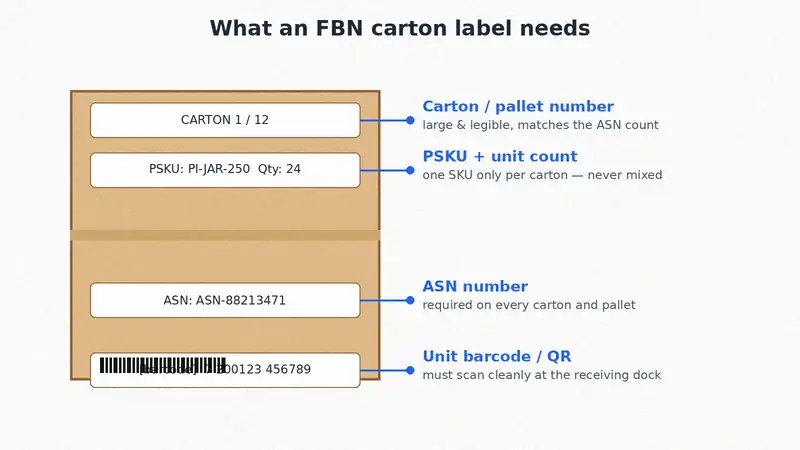
Each carton may hold only one Partner SKU. It must display that PSKU, the total item count inside it, and the ASN (Advance Shipment Notice) number on the outside. Mixing two products in one carton — even from the same brand — is one of the most common reasons an inbound shipment gets flagged during quality checks.
| What goes on the label | Where it appears | Why it matters |
|---|---|---|
| Carton or pallet number (e.g. “CARTON 1”) | Printed directly on the box, large and legible | Matches the count noon’s inbound team expects from your ASN |
| Partner SKU (PSKU) + unit count | Carton label, repeated on the packing list | Confirms one SKU per carton — mixed cartons are rejected |
| ASN number | Every carton and every pallet | Required on all cartons and pallets per noon’s packing policy |
| Unit barcode / QR code | Visible on each individual unit’s packaging | Missing or duplicated barcodes fail the scan at receiving |
For health & beauty and food & beverage products, noon also requires a shared expiry date per batch. Shelf life must meet its category minimum — at least one year for most FBN products at the time of inbound.
Which packaging materials does noon reject on sight?
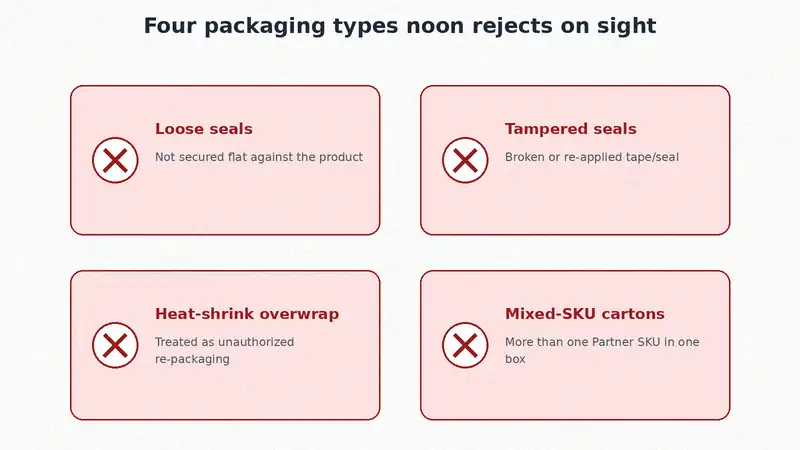
Noon’s inbound quality team rejects loose seals, tampered seals, heat-shrink overwrap, and any carton that was repacked by a third-party carrier in transit. This is a different rejection pattern than Amazon-style FBA inspections. It catches sellers who assume “more sealing is safer.” A tamper-evident sticker that looks secure to a customer can still be read as a tampered or loose seal by noon’s checklist if it is not the type specified for the product category.
Fragile items need a visible “Fragile” label, and anything sold as a bundle must say “sold as set” or “sold as bundle” on the packaging. Otherwise, taping multiple items together counts as an unauthorized attempt to combine separate PSKUs. If you already ship through other Saudi marketplaces, the logic is similar in spirit to the FNSKU and labeling checks covered in our guide to FBA private-label stickers for Amazon.sa sellers. However, the specific label fields, carton rules, and rejected seal types are noon’s own, not Amazon’s. The two checklists are therefore not interchangeable. If your usual seal of choice is a tamper-evident sticker like the ones covered in our tamper-evident security sticker guide for COD packages, check the exact finish against noon’s current rejection list before an FBN shipment. A seal that works for retail customers is not automatically the one noon’s inbound team expects.
What should you order from a printer before your first FBN shipment?
- Unit barcode stickers sized to fit your smallest product face without wrapping around an edge, printed on a material that will not smear if handled during scanning.
- Carton labels large enough to read PSKU, unit count and ASN number from a normal receiving-dock distance. This follows the same bulk-ordering logic as our e-commerce shipping sticker guide. You will be reordering these in batches as your FBN volume grows.
- Category-specific tags — a visible “Fragile” label for breakables, or a “sold as set” label for bundles, printed separately from your branding sticker so it is not missed.
- Lot or batch labels for cosmetics, fragrances, and food & beverage items, since noon requires a lot number and a shared batch expiry date for these categories.
Common mistakes that get FBN shipments rejected
- Printing one barcode and reusing it across size or color variants: noon requires a unique barcode per SKU, and each variant counts as its own SKU.
- Packing two products in one carton to save box space: a carton showing more than one PSKU is flagged during inbound checks.
- Choosing a heat-shrink wrap to look “extra secure”: this is explicitly listed among the packaging types noon’s team rejects.
- Leaving the ASN number off a pallet because it is already on every carton inside it: noon’s policy requires it on both the cartons and the pallet itself.
- Treating a fashion item’s price tag like its sewing tag: only the security tag must be removed; the sewing or swing tag should generally stay attached.
Quick checklist before your first FBN shipment
- ☐ Every unit has its own secure packaging and a unique, scannable barcode.
- ☐ Each carton contains only one PSKU, with the PSKU, unit count and ASN number printed on it.
- ☐ Pallets show their carton or unit count and carry the ASN number too.
- ☐ Fragile and bundled items carry the correct required wording on their label.
- ☐ Food, beauty and fragrance items have lot numbers and a shared batch expiry date.
- ☐ No loose seals, tampered seals or heat-shrink overwrap used anywhere in the shipment.
Top 10 Practical Recommendations for Noon FBN packaging
These steps keep your Noon FBN packaging clear for the inbound team. Apply them before your first shipment.
- Put a scannable barcode on every unit. noon asks for a barcode on the outside of the packaging, and items without one are rejected at quality control, per the FBN packing policy.
- Cover old barcodes. Hide any previous barcode with a cover-up label or a black marker so only one code scans.
- Give each variant its own code. Size and colour variants each need a separate barcode, as the noon barcode page explains.
- Print a readable code under the barcode. A human-readable alphanumeric line helps staff when a scanner fails.
- Pack one SKU per carton. Never split a SKU across boxes, and label loose cartons with the ASN number.
- Label every pallet. Each pallet needs a Pallet ID and the ASN number, and should not mix cartons from different shipments.
- Mark multi-part items. Add the GTIN and a component line such as “1 of 3” to each box of a bulky item.
- Test-scan before the full run. We send a free digital proof first, and you can scan one printed label before ordering the rest. See our product information labels guide.
- Plan label sizes with your packaging. Our packaging checklist for online sellers and carton sealing stickers guide cover the rest.
- Order early. Most orders take 3 to 5 working days, then 24 to 72 hours of shipping, so request a quote well before your inbound slot.
What’s New as of October 2026
As of our reading on 28 October 2026, the noon FBN packing and delivery policy page shows it was published on 22 April 2026 and updated on 28 October 2026. Always check the live page before printing, because rules can change.
The page states that every product needs a scannable barcode on the exterior packaging. It also accepts a partner barcode, a manufacturer EAN, GTIN or UPC, or a QR code. Pallets need a Pallet ID and ASN number, and pallets should stay under roughly 1.8 to 2 metres in height.
The separate barcode page adds that products without a manufacturer barcode can use an alphanumeric code of up to 16 characters. Once a barcode is assigned to an SKU, it cannot be deleted. We could not confirm other new changes, so check the official policy first. You can also browse our sticker printing range.
Frequently Asked Questions about Noon FBN packaging
Does every unit sent to noon need its own barcode?
Yes — noon’s policy states that having a barcode on all units is mandatory, and products without one are rejected at quality checks and cannot be fulfilled.
Can I reuse noon’s own shipping boxes to send inventory to its fulfillment center?
No, noon’s packing guidelines specifically state that its own boxes or cartons should not be used to pack items being sent in.
How many products can go in one carton for an FBN shipment?
Only one Partner SKU per carton; different products or brands must be packed and labeled separately, even if they are shipping on the same pallet.
What packaging gets an FBN shipment rejected the fastest?
Loose or tampered seals and heat-shrink overwrap are named directly in noon’s policy as rejection triggers, alongside missing barcodes and mixed-SKU cartons.
Does noon require a barcode on every product?
Yes. The FBN policy says every product needs a scannable barcode on the exterior packaging.
Can I create my own barcode?
If a product has no manufacturer barcode, noon allows an alphanumeric code of up to 16 characters. Check the noon barcode page for the current rule.
Can a barcode be changed later?
You can upload a new one, but the original stays on the SKU once assigned.
Do you offer a proof before printing?
Yes, we send a free digital proof before printing.
How long does an order take?
Most orders take 3 to 5 working days, then 24 to 72 hours of shipping.
Is shipping free?
Shipping is free for orders of 250 SAR and above, with delivery within Saudi Arabia and to the GCC.
Bringing it together
Passing noon’s inbound quality check the first time is mostly a printing decision made before you pack a single box: one scannable barcode per unit, one PSKU per carton, and the right category-specific label on anything fragile, bundled, or perishable. Our shipping carton sealing stickers guide covers the general carton-sealing side if you also ship direct-to-customer orders alongside your FBN inventory. If you need a durable, scannable option for unit or carton labels, our custom vinyl sticker printing holds up to warehouse handling better than standard paper labels. Request a quote with your unit and carton counts, or message us on WhatsApp, to get your FBN barcode and carton labels printed before your next shipment window.
Sources: noon Partner Help Center — Product Packing Guidelines (FBN), noon Partner Help Center — Barcode Requirements.