

Paper Ink Blog
Tamper-Evident Security Stickers for COD Packages: A Guide for Saudi Online Sellers


Short answer: A tamper-evident security sticker is a seal placed over the opening point of a cash-on-delivery (COD) package that visibly tears or leaves a “VOID” residue pattern if someone opens the box before it reaches the customer. It proves the contents were not opened or swapped in transit, and it is a different product from a return-policy sticker or ordinary carton sealing tape.
Why Do Saudi COD Sellers Need Tamper-Evident Stickers?
Cash on delivery is still one of the most common payment methods for online shopping in Saudi Arabia, and it is also the source of the most sensitive shipping disputes: a package arrives, the customer claims the wrong item, a damaged item, or a missing item, and the store has no physical evidence of what the package actually looked like at the moment of delivery.
A tamper-evident sticker does not prevent every dispute, but it turns an unverifiable “customer’s word against the store’s word” situation into a visible fact: if the package arrives with the seal intact, the contents were not opened between packing and delivery. This is the same category of risk described in cases of package interception and delivery fraud, where proof of an unopened parcel becomes the deciding factor in a dispute.
How Does a Tamper-Evident Seal Actually Work?
A tamper-evident sticker uses an adhesive layer engineered to fail when someone tries to remove it: either the sticker itself shreds into pieces that cannot be reattached, or it leaves a residue pattern spelling “VOID” on the surface underneath. Both outcomes produce the same result — there is no way to reseal the package to look untouched once it has been opened.
This is fundamentally different from a regular sticker or packing tape, both of which can be peeled off carefully and reapplied to a different box without leaving any visible trace of what happened. The underlying principle is known globally as tamper-evident technology, originally developed for pharmaceuticals and high-value goods before becoming common in everyday shipping.
Two Main Types of Tamper-Evident Stickers: Which One Fits Your Packaging?
Not all tamper-evident stickers work the same way. There are two common types, and choosing the wrong one for your packaging material means paying for a security feature that does not actually protect anything.
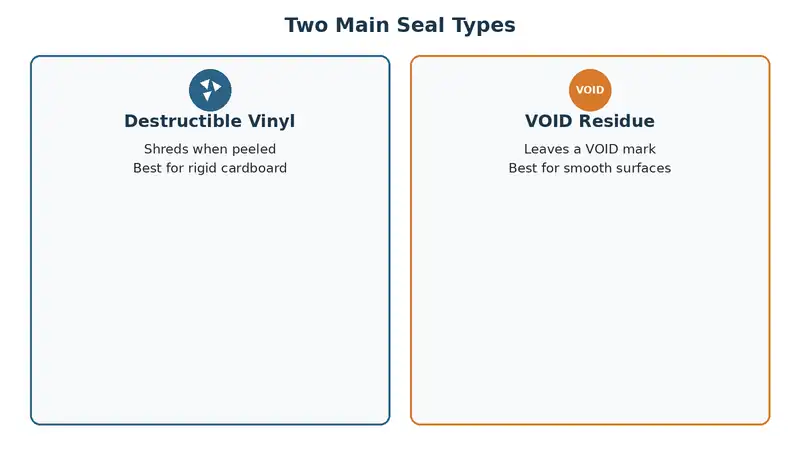
Destructible vinyl: made from a brittle film designed to fragment into small pieces the moment someone tries to peel it. It works best on rigid cardboard boxes where the opening flap is a single clear point.
VOID residue labels: the sticker itself does not shred, but it leaves an adhesive residue reading “VOID” or a repeating pattern on the surface after removal — even if someone lifts it slowly and carefully. These perform more reliably on smoother surfaces such as poly mailers or gift boxes, where brittle vinyl may not bond as well.
A practical rule: if you ship in rigid cardboard, start with destructible vinyl because the damage is obvious from a distance. If you ship in soft mailer bags or smooth surfaces, VOID residue labels tend to hold up better.
Tamper-Evident Seal vs. Carton Sealing Tape vs. Return Policy Sticker
These are three different packaging elements that can look similar to a new store owner, and each one solves a different problem. Mixing them up means printing the wrong item and still not solving the actual issue.
| Element | Core Function | When You Need It |
|---|---|---|
| Tamper-evident seal | Proves the package was not opened before delivery | COD orders, high-value products |
| Return policy sticker | Explains return and exchange terms to the customer | Nearly all orders, regardless of payment method |
| Carton sealing tape/sticker | Closes the box and optionally shows your logo | Every shipment, with no tamper-proof function |
Most serious COD sellers use all three together: carton sealing stickers or tape to close the box, a tamper-evident seal over the actual opening point, and a printed return-policy note attached to the invoice or the outside of the box.
Where Should You Place the Seal on the Package?
Placement determines whether the seal actually does its job. The goal is to cover the real opening point of the box, not just any empty space on the surface.
- Directly across the top carton flap seam: so the sticker spans both moving flaps, not just one fixed panel.
- Over the tape itself, if you already use sealing tape: this stops someone from carefully lifting the tape and reapplying it without a trace.
- Across the final fold of a poly mailer or padded envelope: right where the bag closes, not on a side panel.
A seal placed in the middle of a box, away from the actual opening point, protects nothing — the package can be opened from another side entirely and resealed without ever touching the sticker.

Common Mistakes with Tamper-Evident Stickers
- Placing the seal somewhere that does not cover the real opening point: this defeats its entire purpose.
- Using a regular sticker and calling it a “security seal”: without an adhesive engineered to tear or leave residue, it is decoration, not evidence.
- Relying on the seal alone without a quick photo of the sealed package before shipping: a timestamped photo adds a second layer of proof if a dispute happens.
- Printing a large batch before testing adhesion on your actual box or bag material: some glossy or recycled-fiber finishes reduce how well the tamper layer bonds.
- Leaving out an order number or tracking code on the seal: this makes it harder to match a specific seal back to a specific order during review.
Checklist Before You Order Tamper-Evident Stickers
- ☐ Identified the actual opening point of the package before designing the seal
- ☐ Chose destructible vinyl or VOID residue based on your box or bag material
- ☐ Tested adhesion on the real packaging surface you use
- ☐ Added your store logo and a short contact line to the design
- ☐ Reserved it for COD orders or higher-value items specifically
- ☐ Trained your packing team on correct placement for each package type
Frequently Asked Questions
Do tamper-evident stickers fully prevent COD fraud?
Not completely, but they provide clear visual evidence of the package’s condition at delivery, which reduces unfounded disputes and helps resolve real ones faster.
How is a tamper-evident seal different from a return-policy sticker?
Completely different functions. A tamper-evident seal proves the box was not opened; a return-policy sticker only explains return and exchange terms. Neither replaces the other.
Does every COD order need a tamper-evident seal?
Not necessarily every order — it is most worth the cost for higher-value products or categories that see frequent return disputes.
Can someone remove the seal carefully and reuse the box without leaving a trace?
That is exactly what a properly engineered tamper-evident seal prevents: the adhesive is designed to tear or leave a residue mark the moment anyone attempts to separate it, unlike a standard sticker.
Bringing It Together
A tamper-evident seal is not a replacement for a return-policy sticker or sealing tape — it is an added layer of protection for the single most sensitive moment in a COD order: when the package is opened. If your store relies heavily on cash on delivery, get your design started with packaging stickers or custom vinyl stickers, compare your options with the sticker pricing guide, and request a quote today via Request a Quote or reach out directly on WhatsApp.
