

Paper Ink Blog
Packaging Checklist for Small Online Sellers in Saudi Arabia


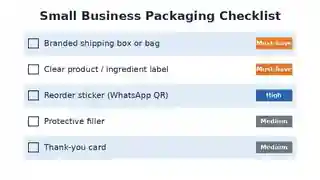
Short answer: a solid packaging checklist for small online sellers in Saudi Arabia covers five things — a branded shipping box or bag, a protective filler, a product or ingredient label, a thank-you card, and a reorder sticker such as a WhatsApp QR code. Skipping any one of these is what makes a package look unfinished, even when the product inside is excellent.
Most packaging advice online is written for sellers shipping through US or European carriers, with US box sizes and US courier norms in mind. It rarely accounts for how orders actually move in Saudi Arabia: through local courier partners, often opened in front of the customer at the door, frequently paid for on delivery. This checklist is built around that reality.
What Actually Goes Into a Small Business Packaging Checklist?
A packaging checklist is not about looking expensive. At its core, packaging and labeling exists to protect a product and communicate what it is — a small business checklist is just that idea scaled down to what actually matters for a handful of daily orders. It is about making sure every order arrives in one recognizable, intact piece, with nothing missing that the customer needed.
In short: the outer box or bag, an inner protective layer, a clear product label, a small thank-you card, and a way for the customer to reorder or leave a review. Together these five elements cover receiving, unboxing, and everything that happens after the order is opened.
Why Saudi Sellers Need a Different Checklist Than Global Guides
Most packaging checklists assume a fixed courier network, standard box sizes, and English-only labeling. None of that maps cleanly onto a small Saudi business shipping through a local courier, selling mainly through Instagram or WhatsApp rather than a full e-commerce platform, and often needing bilingual Arabic-English labels on the same package.
That gap is where most small sellers waste money: buying generic packaging supplies that do not match how their orders actually move, rather than building a short list around their real shipping conditions.
The Core Packaging Checklist
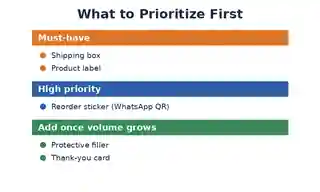
In short: prioritize the outer box, the product label, and the reorder sticker first, since these three solve the most common first-order complaints — the protective filler and the thank-you card are worth adding once your order volume and repeat-customer rate justify the extra printing cost.
| Packaging element | Purpose | Priority |
|---|---|---|
| Shipping box or bag | Protects the product, carries your brand | Must-have |
| Product or ingredient label | Identifies contents, meets basic labeling expectations | Must-have |
| Reorder sticker (WhatsApp QR) | Turns delivery into a direct reorder channel | High |
| Protective filler | Prevents damage in transit | Medium |
| Thank-you card | Builds repeat-customer relationships | Medium |
Which Items Should You Prioritize First?
If you are shipping your first orders, start with a printed shipping box that clearly shows your brand name, plus a product label that lists what is inside. These two elements alone solve the most common complaint about unbranded orders: a plain box with no indication of who it came from or what is inside.
Once you are shipping consistently, add a reorder sticker printed on the packaging itself, similar to the WhatsApp QR code approach many small Saudi sellers already use to turn a delivered order into a direct reorder conversation. A custom thank-you card is the next upgrade once repeat orders start mattering more than first-time sales.
Common Mistakes Small Sellers Make With Packaging
Buying packaging before shipping a single order. It is tempting to order a large batch of branded boxes early, but sizing and material needs often change once you see how your actual products ship.
Printing only in Arabic or only in English. A large share of Saudi shoppers expects to see both languages on a label, especially for anything food, beauty, or health-related — leaving one language off can read as incomplete rather than intentional.
Treating the thank-you card as optional decoration. A short, genuine note costs very little to add and is one of the few packaging elements that directly encourages repeat orders.
Ignoring how the package is opened. Many Saudi orders are opened by the customer in front of the courier at the door — packaging that looks messy or falls apart during that moment reflects on the brand immediately, before the product is even seen.
Packaging Checklist Recap
Frequently Asked Questions
Do I need a thank-you card for every order? Not necessarily. It matters most once repeat customers become a meaningful share of your orders — for a brand-new store, the box and label matter more.
What packaging elements matter most for a first shipment? A branded shipping box and a clear product label. These two alone solve the most common complaint from first-time customers: an unbranded, unclear package.
Is bilingual labeling actually necessary in Saudi Arabia? For food, beauty, or health-related products it is expected by most customers, even when not strictly required, since it removes any doubt about what is inside.
How do small sellers get customers to reorder without a full loyalty program? A printed reorder sticker with a direct WhatsApp link on the packaging itself is the simplest version many small Saudi sellers already use successfully.
Bringing It Together
A packaging checklist does not need every element from day one. Start with a branded box and a clear label, then add a reorder sticker and a thank-you card as your order volume grows. Browse the shipping carton options to see what’s available, and for sellers building this list for the first time, general small business support resources from Monsha’at cover the operational side. When you’re ready, the request a quote page or a message on WhatsApp is the fastest way to get real pricing on the printed elements themselves.








5 thoughts on “Packaging Checklist for Small Online Sellers in Saudi Arabia”