
Paper Ink Blog
SFDA-Compliant Product Label Basics for Small Saudi Brands

A compliant product label in Saudi Arabia needs safety and usage information in Arabic (or Arabic and English together), a permanent country-of-origin mark, and — for food items — the product name, packer’s name, ingredient list, and shelf life. Getting these basics right on your printed label from day one saves you a reprint later.
Most small Saudi brands — home-based cosmetics, food products, candles, skincare — discover labeling rules only after a customer, a marketplace, or a shipment gets flagged. The regulatory guides that do exist are written for large manufacturers going through full SFDA registration, not for someone printing their first batch of 100 stickers. This guide covers the printing-relevant basics: what has to be on the label, and how to plan your artwork so it prints correctly the first time.
Who regulates product labels in Saudi Arabia?
The Saudi Food and Drug Authority (SFDA) is the primary regulator for food, cosmetic, and personal care product labels sold in Saudi Arabia. Separately, general consumer product labeling and country-of-origin marking fall under Saudi standards administered through SASO. If your product is food, a cosmetic, or a supplement, SFDA rules apply specifically to your label content — and the Authority publishes guidance for home-manufactured products on its own site, since home-based small brands are a recognized category, not an edge case.
What information is legally required on a Saudi product label?
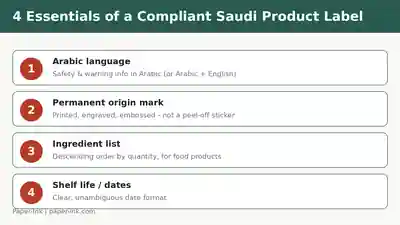
At minimum, a compliant label needs: the product name, the country of origin marked permanently, and — for food products — the packer’s name, a full ingredient list in descending order of quantity, usage instructions where relevant, and the shelf life. Safety and warning information must appear in Arabic, or in both Arabic and English together, according to Saudi Arabia’s official labeling and marking requirements as summarized in the U.S. Department of Commerce’s Saudi Arabia country commercial guide.
The country-of-origin requirement is stricter than many small brands expect: it has to be applied in a way that cannot be removed — through printing, engraving, embossing, or sewing, not a sticker that peels off easily. A well-printed vinyl label applied correctly satisfies this without needing anything more exotic.
| Label element | Required for | Practical note |
|---|---|---|
| Arabic language (safety/warnings) | All products | Arabic-only or bilingual Arabic-English is acceptable |
| Permanent country of origin | All products | Must not be removable — a securely printed label qualifies |
| Ingredient list (descending order) | Food products | List by weight/quantity, largest ingredient first |
| Shelf life / expiry | Food products, cosmetics | Print date format clearly, avoid ambiguous DD/MM vs MM/DD |
Do home-based and small manufacturers need SFDA approval?
Yes — SFDA maintains a specific licensing path for home-manufactured products, separate from full industrial registration. The requirement exists regardless of your sales channel: selling through Instagram, a local bazaar, or your own online store does not exempt a food or cosmetic product from SFDA rules. Confirm your specific product category’s requirements directly with SFDA before your first commercial print run, since requirements vary by product type (food, cosmetics, supplements). Once your label content is approved, the packaging around it matters too — see our breakdown of what actually drives custom packaging cost in Saudi Arabia when budgeting your first compliant batch.
Can I print a bilingual Arabic-English label instead of two separate labels?
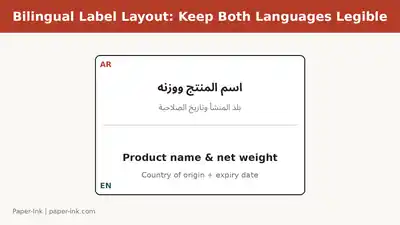
Yes, and for most small brands it is the more practical option. A single bilingual label keeps your packaging consistent whether the customer reads Arabic or English first, and it satisfies the Arabic-language requirement without needing separate SKUs. Layout matters here — cramming two languages onto a small sticker without planning the hierarchy is one of the most common mistakes we see. Our guide on bilingual Arabic-English product label layout covers how to structure the two languages so both stay legible at small sizes.
Common mistakes small brands make with their first compliant label
- Treating Arabic text as an afterthought: adding a small Arabic sticker to an English label later, instead of designing both languages into the layout from the start.
- Using a country-of-origin sticker that peels easily: a low-adhesion label technically fails the “permanent” requirement if it can be removed intact.
- Skipping SFDA confirmation because the product is “small batch”: production volume does not change whether food or cosmetic labeling rules apply.
- Printing expiry dates in an ambiguous format: a date written as 03/09/2026 reads differently depending on the customer’s convention — spell out the month where possible.
- Choosing a material that fails before the product sells through: a label that fades or peels in storage undermines compliance even if the content was correct at printing. If your product faces heat, humidity, or refrigeration, see our guide on why product labels peel in heat and humidity.
A quick pre-print checklist
- ☐ Safety/usage information is in Arabic, or Arabic and English together.
- ☐ Country of origin is marked in a way that cannot be peeled off intact.
- ☐ For food/cosmetics: ingredient list, shelf life, and packer’s name are included.
- ☐ You have confirmed your specific product category’s SFDA requirements directly.
- ☐ The label material matches your storage and shipping conditions.
- ☐ You have reviewed a physical or digital proof before the full print run.
Frequently asked questions
Does my product need Arabic on the label if I only sell online in Saudi Arabia?
Yes. The Arabic-language requirement for safety and warning information applies regardless of whether you sell in a physical store or online.
What happens if I skip SFDA requirements because I’m a small home-based brand?
Home-manufactured products are a recognized SFDA category with their own licensing path — size of production does not exempt you from labeling and registration requirements for food or cosmetic items.
Is a printed sticker enough to meet the “permanent” country-of-origin rule?
Yes, as long as the label is applied with adhesive strong enough that it cannot be peeled off intact — a securely printed vinyl label satisfies this in practice.
Can I use the same label design for private-labeled or imported products?
The labeling content rules apply regardless of whether you manufacture the product or import and rebrand it. If you resell imported goods under your own brand, see our guide on private-label stickers for Saudi resellers for the branding side of this.
Bringing it together
Compliant labeling is not complicated once you know the four essentials: Arabic-language safety information, a permanent country-of-origin mark, complete ingredient and shelf-life details for food products, and a label material that survives your actual storage conditions. Confirm your specific product category with SFDA directly, then print once you have a design that covers all four. Ready to print your compliant label? Browse our professional vinyl sticker printing, get a free quote at Request a Quote, or message us directly on WhatsApp to discuss your order.
Related reading: Local Agricultural Product Label Printing in Saudi Arabia: A Material and Compliance Guide