
Paper Ink Blog
Local Agricultural Product Label Printing in Saudi Arabia: A Material and Compliance Guide

Short answer: the right label for a local agricultural product — honey, packaged dates, bottled olive oil, or similar — depends on what the product itself does to the label: honey and oils need a grease- and moisture-resistant material, while dry products like dates need a label that bonds well to poly or kraft packaging, and every option still needs the basic food information (net weight, production/expiry dates, producer name and contact) that Saudi food-labeling rules expect. The sections below cover material choice by product type, what belongs on the label itself, and sizing, with a quick comparison table and a pre-print checklist.
This guide is written for small producers and home-based sellers — a beekeeper selling jars directly, a family bottling olive oil from their own trees, or a small shop packaging dates for gift boxes — not large-scale commercial exporters, who should always confirm exact requirements against official Saudi Food and Drug Authority (SFDA) guidance for their specific product and sales channel.
Why do local agricultural products need different label materials than packaged dry goods?
Honey is viscous and sticky; a drop on the jar’s edge during filling or use sits directly on the label. Olive oil behaves differently but just as harshly — oil seeps into plain paper and leaves a translucent stain that lifts ink and weakens adhesive within days. Dates and similar dry products are gentler on the label itself, but their packaging (poly bags, kraft pouches) needs an adhesive that actually grips those surfaces rather than a generic paper-label adhesive.
Refrigeration adds a second layer of difficulty for honey and oils: moving between cold storage and a warm shop counter creates condensation on the container surface, which is exactly when a paper label starts to wrinkle or peel.
Section summary: the printing problem for agricultural product labels is almost never the design — it is choosing a material that survives what the product itself does to it.
What label material suits honey, olive oil, and packaged dates?
Plain paper stickers are the weakest option for anything oily or liquid-adjacent. A water- and grease-resistant vinyl label consistently performs best for honey and olive oil, while a clear label works well when the goal is to let the product’s natural color show through as part of the branding.
| Product type | Main label risk | Best material |
|---|---|---|
| Honey (jars) | Sticky residue, cold-storage condensation | Water-resistant vinyl or clear label |
| Olive oil (bottles) | Oil seepage staining paper, adhesive failure | Oil- and water-resistant vinyl |
| Packaged dates (bags/boxes) | Adhesion to poly or kraft surfaces | Vinyl label matched to the packaging surface |
If your product line also includes something like locally roasted coffee or fresh-pressed juice alongside honey or oil, Paper-Ink’s existing Custom Coffee Bag Labels and Custom Juice Labels are real examples of the same moisture-resistant approach applied to other small-batch local products, sized for their own typical packaging. Browsing the full sticker printing category is a useful next step before finalizing a single material across your whole product line — pricing and minimum order quantities can vary by material and finish.

Section summary: water- and oil-resistant vinyl is the safer default across honey, oil, and dates, and plain paper is rarely worth the risk for any product that touches moisture or oil.
What information belongs on a local agricultural product label in Saudi Arabia?
If you sell a packaged food product directly to consumers in Saudi Arabia, the label effectively functions as a basic food declaration, which falls under general Saudi Food and Drug Authority (SFDA) labeling guidance. Commonly expected elements on a packaged food label include the product name, net weight, production and expiry dates, the producer’s name and a way to contact them, and the country of origin.
This section is a general planning overview, not a substitute for reading the SFDA’s own published requirements in full. If you plan to sell through a major e-commerce platform or supply retail stores, review the official guidance directly before your final print run, since exact expectations can vary by package size and sales channel.
Section summary: a correct food label protects your product from being turned away by stores or platforms, and builds buyer trust the moment someone picks up the jar or bottle.
How do you size a label for jars, bottles, and date boxes?
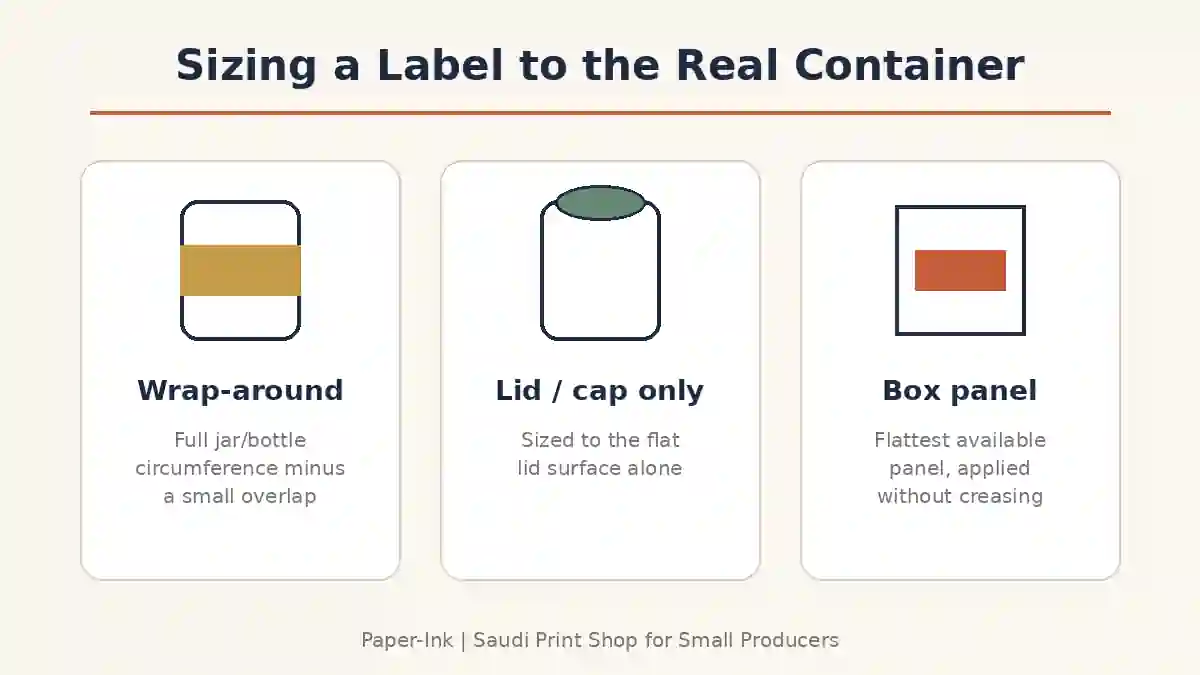
In short, measure the actual container first: a wrap-around label needs the full circumference of the jar or bottle minus a small overlap margin, a lid or cap label is sized to the flat lid surface alone, and a box label for packaged dates is sized to the flattest available panel so it applies without creasing. The most common sizing mistake is designing to a generic template size before measuring the real container, which causes wrinkling on curved glass or awkward overhang on a box edge.
For honey jars specifically, decide early whether you want a small lid-only label or a full wrap that covers more of the jar — a full wrap carries more branding and information space but costs more per unit and must be cut precisely to the jar’s actual height. If you are unsure which finish to start with, Paper-Ink’s Professional Vinyl Sticker Printing line is a practical reference point for the general-purpose waterproof material this guide recommends across honey, oil, and dates.
Section summary: sizing follows the container, not the design — always measure your actual jar, bottle, or box before finalizing the print-ready file.
Common mistakes when printing agricultural product labels
- Using plain paper stock for honey or oil: it looks fine on day one, then smears or peels once the product’s moisture or oil reaches the label.
- Skipping the net weight or production date: a beautifully designed label without basic food information risks rejection from stores or online marketplaces.
- Designing to a stock template size instead of the real container: causes wrinkling on curved jars or gaps on box labels.
- Treating every agricultural product the same: an adhesive and material that work for a dry date box will not hold up on a sweating honey jar.
- Forgetting the per-unit label cost in pricing: small producers often price the product without accounting for label cost per jar or bag, quietly shrinking their margin.
Quick checklist before printing agricultural product labels
- ☐ Identified the product type (honey, oil, dried goods) and its specific label risk.
- ☐ Chose a water- and/or oil-resistant material instead of plain paper where needed.
- ☐ Measured the actual jar, bottle, or box rather than using a generic template size.
- ☐ Included net weight, production/expiry dates, and producer contact information.
- ☐ Checked current SFDA guidance if selling through a store or online platform.
- ☐ Added the per-unit label cost into your product pricing.
Frequently asked questions about agricultural product label printing
Is a clear label a good choice for honey or olive oil?
Yes, as long as the underlying material is water- and oil-resistant — a clear label lets the product’s natural color show through while still holding up against moisture and oil.
Do home-based food sellers in Saudi Arabia need to follow the same labeling rules as large brands?
The basic expectations — net weight, dates, producer contact — generally apply to any packaged food sold to consumers, though it is worth checking current SFDA guidance directly if you plan to scale beyond direct, informal sales.
What is the biggest difference between labeling honey and labeling packaged dates?
Honey labels need to resist moisture, stickiness, and cold-storage condensation, while date packaging labels mainly need an adhesive suited to poly or kraft surfaces rather than resisting liquid exposure.
Where can a small producer order agricultural product labels in small quantities?
A specialized sticker and label printer is generally a safer choice than home printing for color consistency and genuine material durability against real honey, oil, or packaging conditions.
Bringing it together
A successful agricultural product label matches its material to what the product actually does to it, carries the basic food information buyers and stores expect, and is sized to the real container rather than a generic template. Paper-Ink is a Saudi print shop that works with small producers on stickers and packaging built for real handling conditions, not just a flat mockup. Request a quote from Paper-Ink or message us directly on WhatsApp with your product type and container size.
Related reading: Get Ready for GTA 6: A Pre-Launch Checklist for November 19