
Paper Ink Blog
Bilingual Wedding Invitations in Saudi Arabia: Laying Out Arabic and English on One Card

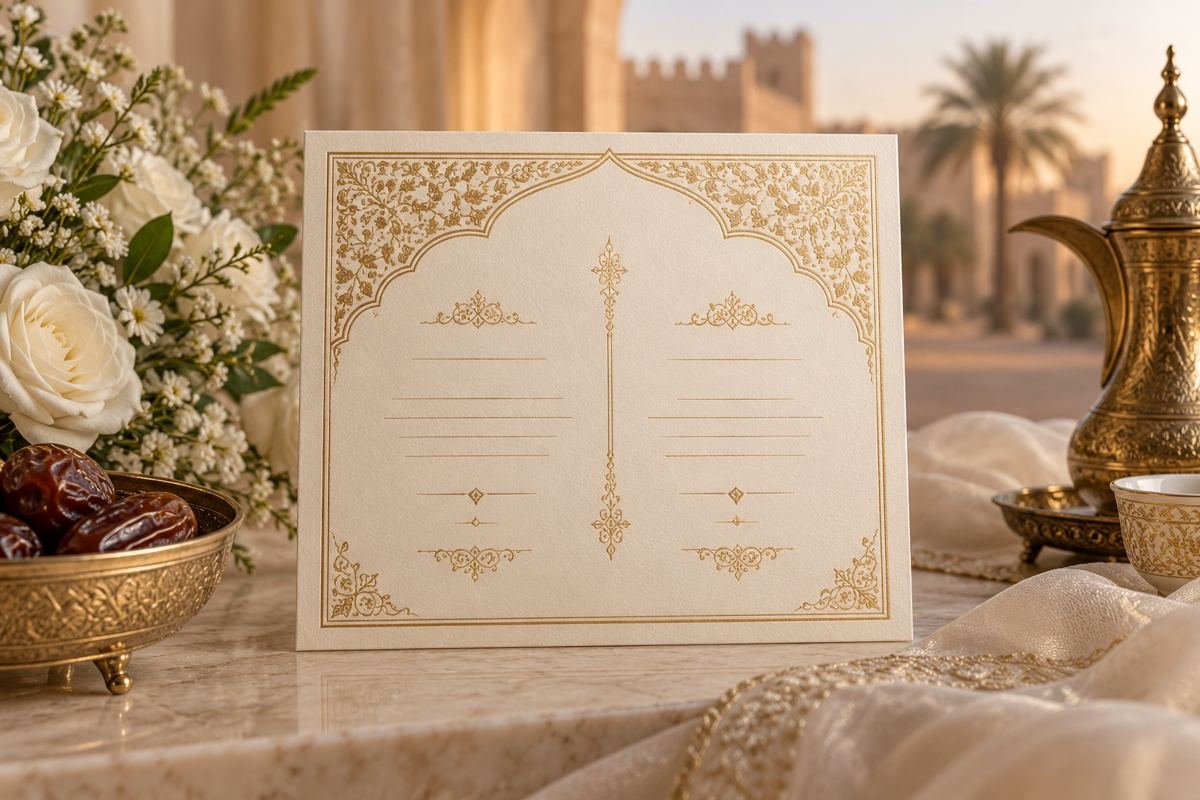
Short answer: for bilingual wedding invitations in Arabic and English, put each language in its own block rather than mixing them line by line. Either print Arabic on the front and English on the back, or split one side into two columns with Arabic on the right and English on the left. Keep names, dates and the venue identical in both versions, and have a native reader of each language check the proof.
Weddings in Saudi Arabia increasingly bring together families from different countries, colleagues from international workplaces and relatives who read English more easily than Arabic, or the reverse. A bilingual card avoids printing two separate runs, but only if the layout respects how each script reads.
Which bilingual layout works best?
| Layout | How it works | Best for |
|---|---|---|
| Front and back | Arabic on one side, English on the other | Formal invitations with longer text |
| Two columns | Arabic right, English left, aligned row by row | Short invitations where guests compare details |
| Folded card | Arabic on the right inner page, English on the left | Invitations with a verse or opening line |
| Main card + insert | Arabic main card with a small English insert card | Mostly Arabic guest lists with a few English readers |
Why mixing the two languages line by line causes problems
Arabic reads right to left and English left to right. When both appear in the same line or paragraph, punctuation, numbers and names can flip position, a problem the W3C explains in its guidance on right-to-left text direction. On a printed card the same issue appears as dates shown in the wrong order or a bracket that faces the wrong way. Separate blocks avoid it entirely. The same principle applies to product packaging, as covered in our guide to bilingual Arabic–English labels.
Getting names, dates and venue right in both languages
- Names: agree on one English spelling for each name before design starts and use it everywhere, including on thank-you cards later.
- Dates: include the Hijri and Gregorian dates in Arabic, and at least the Gregorian date and weekday in English.
- Venue: write the venue name exactly as it appears on maps in each language, and add one QR code that works for both.
- Time: use a clock time in English even if the Arabic version says “after Isha prayer”, so international guests know when to arrive.
Choosing fonts that sit well together
Pick an Arabic typeface first, then an English typeface with similar weight and contrast. A delicate Arabic calligraphic font next to a heavy English sans serif makes one language look like an afterthought. Keep the English slightly smaller in size, because Latin letters appear larger than Arabic at the same point size.
Proofing bilingual wedding invitations
- Ask one native Arabic reader and one fluent English reader to check the free digital proof separately.
- Compare every date, time and name between the two versions line by line.
- Scan the QR code from two different phones.
- Check the folded or back side in the proof, not only the front.
If you are also preparing favours, our wedding and event favour packaging guide covers matching labels and boxes, and our thank-you card wording ideas help with the follow-up cards.
Do you need a designer for a bilingual card?
Not necessarily, but bilingual layouts are where design help pays off most. Paper-Ink offers design and file preparation, so you can send both texts and we arrange them so each language reads naturally.
Top 10 Practical Recommendations for Bilingual Wedding Invitations
These steps keep bilingual wedding invitations clear, balanced and ready to print. Follow them before you approve the design.
- Separate the two languages. Give Arabic and English their own blocks, either front and back or two columns.
- Put Arabic first. Place Arabic on the front or the right column, and English on the back or the left column.
- Keep every detail identical. Names, dates and the venue must match word for word in both versions.
- Write the English date in full. Use the weekday plus the Gregorian date so international guests understand it at once.
- Pick fonts that share a weight. An Arabic font and a Latin font of similar thickness look balanced together.
- Leave generous margins. Arabic script needs more height, so avoid squeezing both blocks into a small card.
- Add a QR code for the venue. A single code saves space and works for both language groups.
- Have two native readers proof it. One Arabic reader and one English reader should check the digital proof. For matching tone in follow-up cards, see our thank-you card wording guide.
- Match the favors to the card. Use the same colors and fonts, and see the wedding favor packaging guide.
- Order early. Most orders take 3 to 5 working days, then 24 to 72 hours of shipping, and our design services can prepare the file.
What’s New as of October 2026
We found no new confirmed update about bilingual wedding invitations in Saudi Arabia as of October 2026. Layout rules for Arabic and English remain stable.
The W3C’s guidance on text direction for bidirectional content notes that inline stretches of mixed-direction text may need extra markup. That matters if you also publish the invitation online.
If you mail printed cards, confirm each guest’s National Address on the Saudi Post website. Then compare options in our wedding and anniversary gift ideas for matching gifts.
Frequently Asked Questions About Bilingual Wedding Invitations
Should Arabic or English come first on a bilingual wedding invitation?
In Saudi Arabia, Arabic usually comes first or on the front, with English on the back or in the left column.
Can I print both languages on one side?
Yes, in two separate columns aligned row by row. Avoid mixing both languages in the same line.
Which date format should the English version use?
Use the weekday plus the Gregorian date written out in full. Add the Hijri date to the Arabic block if you wish.
Do I need a designer for a bilingual card?
It helps, because pairing Arabic and Latin fonts takes care. We offer design and file-preparation help.
Will I see a proof before printing?
Yes, you receive a free digital proof to review before production.
How long does printing and delivery take?
Most orders take 3 to 5 working days, then 24 to 72 hours of shipping.
Do you deliver outside Saudi Arabia?
Yes, we deliver within Saudi Arabia and to GCC countries.
Is shipping free?
Shipping is free within Saudi Arabia for orders of 250 SAR and above.
Start your bilingual invitation
Send both texts and your guest count on WhatsApp and we will reply with a free digital proof. Orders of SAR 250 or more ship free anywhere in Saudi Arabia.