
Paper Ink Blog
Dry-Cleaning & Laundry Printing Essentials for Saudi Arabia


Laundry printing starts with three items every shop needs. Short answer: A dry-cleaning or laundry business in Saudi Arabia needs three printed items at minimum to run smoothly: serialized garment tags for tracking, a durable order ticket or carbonless receipt for the counter, and branded pickup bags customers recognize. Getting the material right on each one — not just the design — is what prevents lost garments and faded tags after a single wash cycle.
Most new laundry and dry cleaning shop owners in Saudi Arabia focus on signage and logo design first, then realize mid-season that their garment tags smudge in steam, their order pads run out mid-week, and their delivery bags look identical to every other shop on the street. Many of these shops are registered as small enterprises supported through programs like Monsha’at, Saudi Arabia’s SME authority — which makes getting the operational basics right, printing included, part of building a shop that scales past a single location. This guide walks through what actually holds up in a working laundry environment.
What garment tags actually need to survive
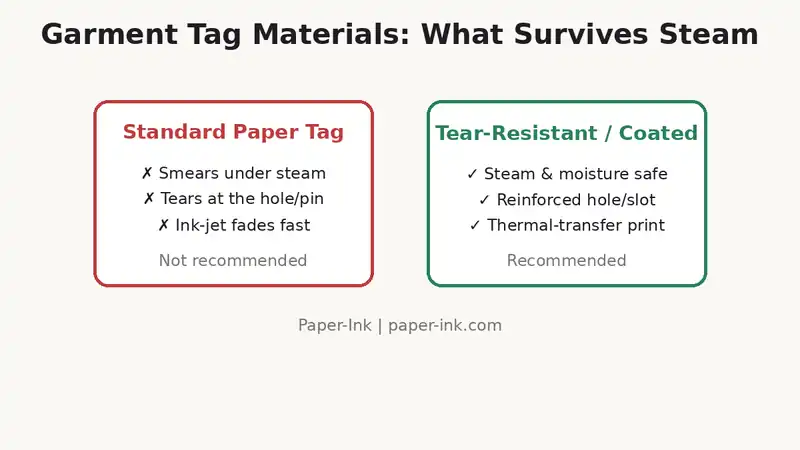
A garment tag on a dry-cleaned item goes through heat, steam, and sometimes solvent exposure before the customer ever sees it again. A plain paper tag with ink-jet printing will smear or tear off inside the machine. The tag needs three things: a tear-resistant stock (synthetic or coated paper, not standard office paper), a hole or slot reinforced enough to survive the pinning or stapling process, and print that doesn’t fade under steam — which usually means thermal-transfer or properly cured ink rather than a quick inkjet print.
Serialized numbering matters just as much as the material. Each tag should carry a unique number that matches the customer’s receipt, so staff can match garments to orders without reading handwriting. The same heat-and-moisture problem shows up on product packaging generally — see why product labels peel in heat and humidity for the adhesive and material science behind it, since a dry-cleaning tag faces the same steam exposure a peeling shipping label faces outdoors.
Order tickets and receipts: carbonless pads solve the counter workflow
A laundry counter needs a ticket that gives a copy to the customer and keeps a copy in the shop — without anyone running to a photocopier between customers. Carbonless (NCR) order pads do exactly this: write once, and the pressure-sensitive layers duplicate the order details, item count, and promised pickup date onto both copies instantly.
A two-part or three-part carbonless pad sized for counter use is the standard solution for dry cleaners, tailors, and laundromats that need an instant duplicate without a printer at the counter. The carbonless order pad guide for Saudi restaurants, cafés, and food trucks covers the same pad format and copy structure — the mechanics transfer directly to a laundry counter, only the fields on the ticket change (garment count and service type instead of menu items).
Pickup bags: the detail customers actually notice
A customer collecting dry-cleaned clothes judges a shop partly by what the clothes come wrapped in. A plain clear poly bag with no branding reads as generic; a bag printed with the shop name, a local phone number, and basic care icons reads as a business that pays attention to detail. A small security seal sticker across the bag’s fold is also a simple way to signal that an order hasn’t been opened since it left the counter. This is also where small online sellers in Saudi Arabia and dry-cleaning shops face the same packaging decision from different angles — branded presentation at the point of handoff builds repeat business either way.
Repeat business is also where a simple loyalty mechanic pays off. A dry cleaner that stamps a printed loyalty card at pickup — “every 10th order free” or a similar offer — gives regular customers a reason to skip the shop two streets over, using the same stamp-card format cafés and restaurants already rely on in Saudi Arabia.
Comparing the three printed items
| Item | Material that holds up | What fails if you cut corners |
|---|---|---|
| Garment tags | Tear-resistant synthetic or coated stock, reinforced hole | Smearing, tearing, lost garment matching |
| Order tickets | 2–3 part carbonless pad | No duplicate copy, disputes at pickup |
| Pickup bags | Printed poly or kraft bag with shop branding | Generic look, no repeat-customer recall |
How much does setting this up cost?
There is no fixed published price for a full garment-tag, order-pad, and bag set, because the cost depends on quantity, tag material, and bag size — and Paper-Ink prices every order individually rather than publishing flat rates that would mislead a different quantity. As a general rule in Saudi print production, ordering tags, pads, and bags together in one batch, rather than three separate small orders, keeps the per-unit cost down across all three items.
Common mistakes laundry shop owners make
- Choosing a cheap, non-tear-resistant tag stock to save a small amount upfront, then losing far more in misplaced-garment disputes.
- Running out of carbonless pads mid-week because the reorder quantity was set too low for actual counter volume.
- Using unbranded bags and missing an easy, repeated brand impression at the exact moment the customer picks up their order.
- Skipping the digital proof step on tag numbering, which risks a full batch printed with duplicate or skipped serial numbers.
- Not matching tag size to the pinning or stapling method the shop actually uses, causing tags to tear off in the machine.
Checklist before you order
- Confirm the tag material is tear-resistant and steam-safe, not standard paper.
- Decide on 2-part or 3-part carbonless pads based on how many copies your workflow needs.
- Choose a bag size and material that fits your most common order (single item vs. family bag).
- Review the free digital proof for tag numbering sequence before the full batch prints.
- Order tags, pads, and bags in one combined batch to avoid repeated small reorders.
- Confirm production and shipping timing against your next expected reorder date.
Frequently asked questions
Do garment tags need to be waterproof, or just steam-resistant? Steam resistance matters most for dry cleaning specifically; a shop that also handles wet laundry or water-based spot treatment should ask for a tag stock rated for both.
Can the order ticket include the shop’s WhatsApp number for pickup reminders? Yes — adding a WhatsApp number directly on the carbonless ticket is a simple way for customers to confirm pickup timing without a phone call.
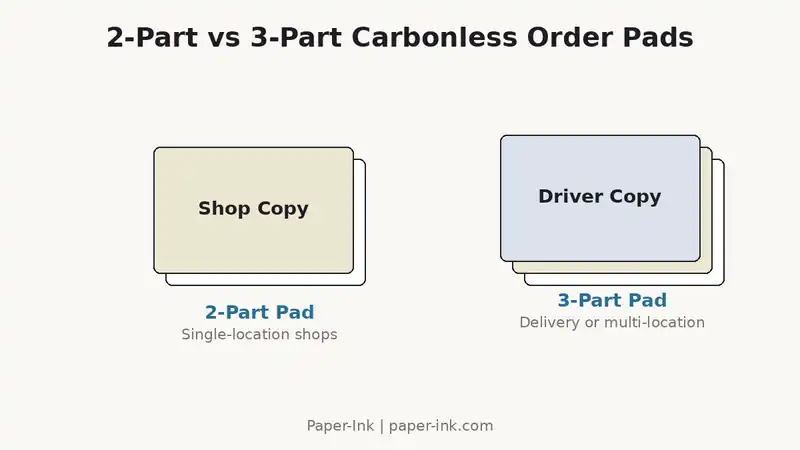
Is a 2-part or 3-part carbonless pad better for a small laundry counter? A 2-part pad (customer copy and shop copy) covers most single-location shops; a 3-part pad adds a copy for a delivery driver or a second location.
Do pickup bags need to be a specific size for Saudi Arabia’s climate? Not specifically for climate, but a bag sized generously enough to avoid pressing on pressed garments helps keep items wrinkle-free until the customer gets home.
Bringing it together
Garment tags, order tickets, and pickup bags aren’t separate purchases — they’re one connected workflow, and the material choice on each one determines whether that workflow holds up on a busy day. Request a quote for your shop’s tag, pad, and bag set, or reach out directly on WhatsApp to confirm sizing and quantities before your next reorder.
