

Paper Ink Blog
Carbonless Order Pads for Saudi Restaurants, Cafés and Food Trucks: Sizes, Copies and Printing Guide

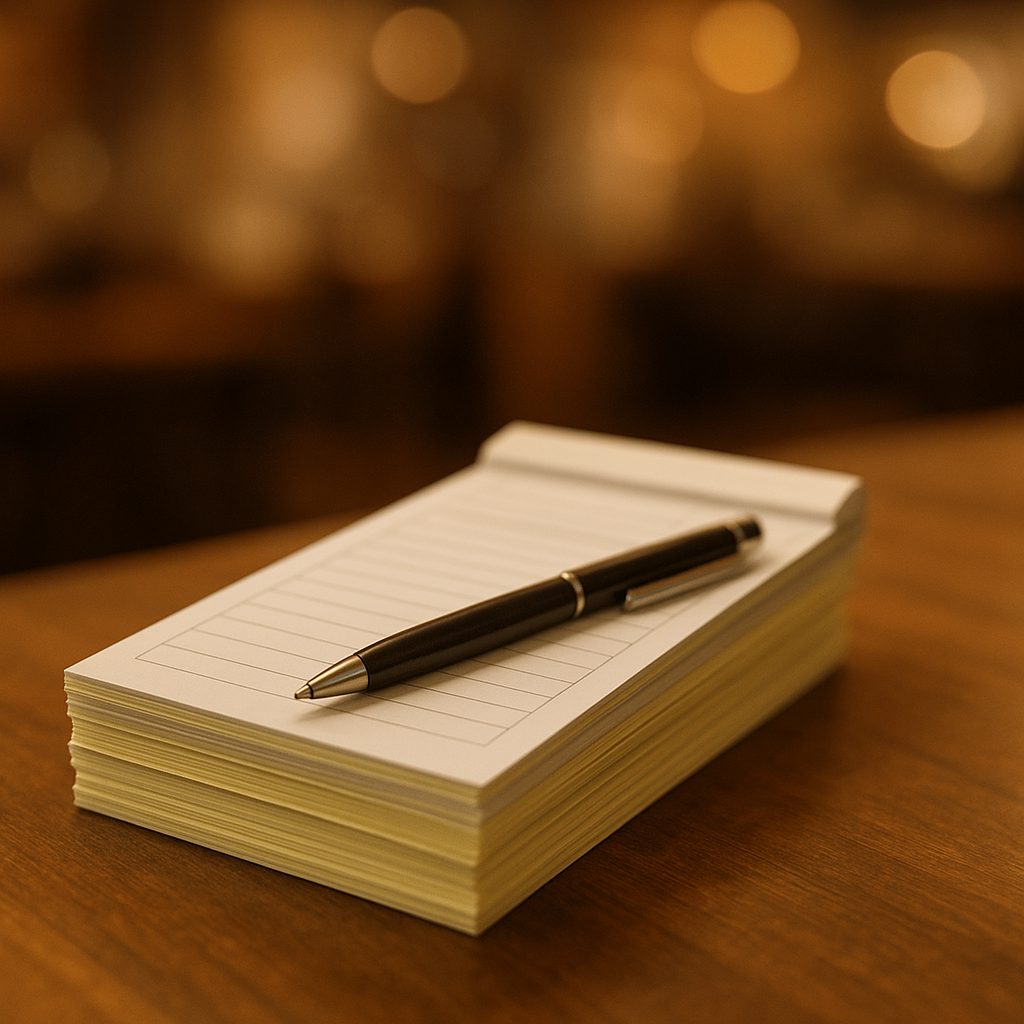
Short answer: Most small restaurants and cafés in Saudi Arabia need a 2-part carbonless order pad — one copy for the kitchen, one for the till or customer — while busy food trucks and dine-in restaurants with separate billing usually need 3 parts. The wrong copy count is the single biggest reason a restaurant reorders pads within weeks.
Search results on order pads are mostly generic stationery listings from UK, US or Australian suppliers, with no guidance for a Saudi food business choosing between copy counts, paper sizes, or whether to print in Arabic, English, or both. This guide covers what actually matters before you order: how many copies you need, what size fits your counter or apron pocket, and what should be pre-printed on every ticket so staff stop writing the same details by hand.
How Many Copies Does Your Order Pad Actually Need?
A 2-part pad (original plus one carbonless copy) works for most counter-service cafés and small restaurants: one ticket goes to the kitchen, the top sheet stays with the till for the bill. A 3-part pad adds a copy for a second checkpoint — a drink station, a delivery rider, or a manager’s control copy — and suits busier dine-in restaurants or food trucks running two prep stations at once.
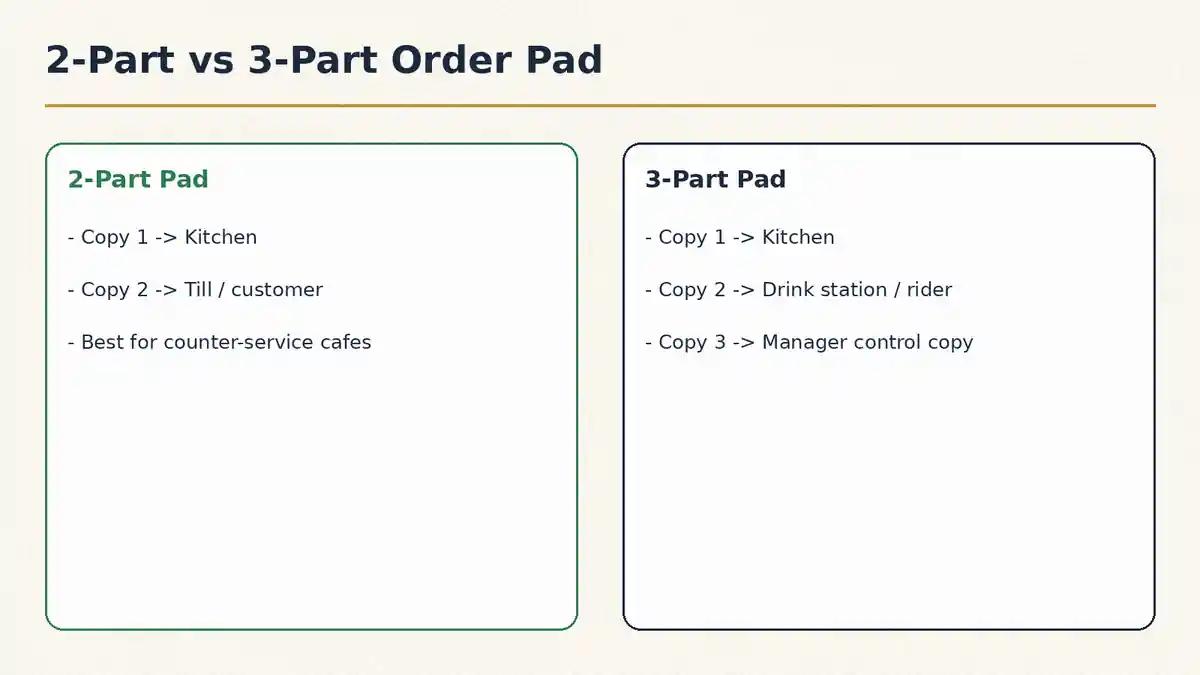
Rule of thumb: count how many separate stations physically need to see the same order at the same time, and that number is your copy count — not how “thorough” you want the record to be. Ordering an extra copy nobody reads just slows down the server tearing it off.
What Size Order Pad Fits Your Restaurant or Food Truck?
| Pad size | Best for | Why |
|---|---|---|
| Small (around 10.5 × 7 cm) | Food trucks, small cafés, apron pocket use | Fits in a server’s pocket or apron for fast table-to-kitchen runs |
| Medium (around 14.8 × 10.5 cm) | Full-service restaurants with longer order lines | More room per line for modifiers and special requests |
| Large (around 16.5 × 9.5 cm, landscape) | Table-service restaurants with multi-item orders | Wider format fits several menu items and a table number clearly |
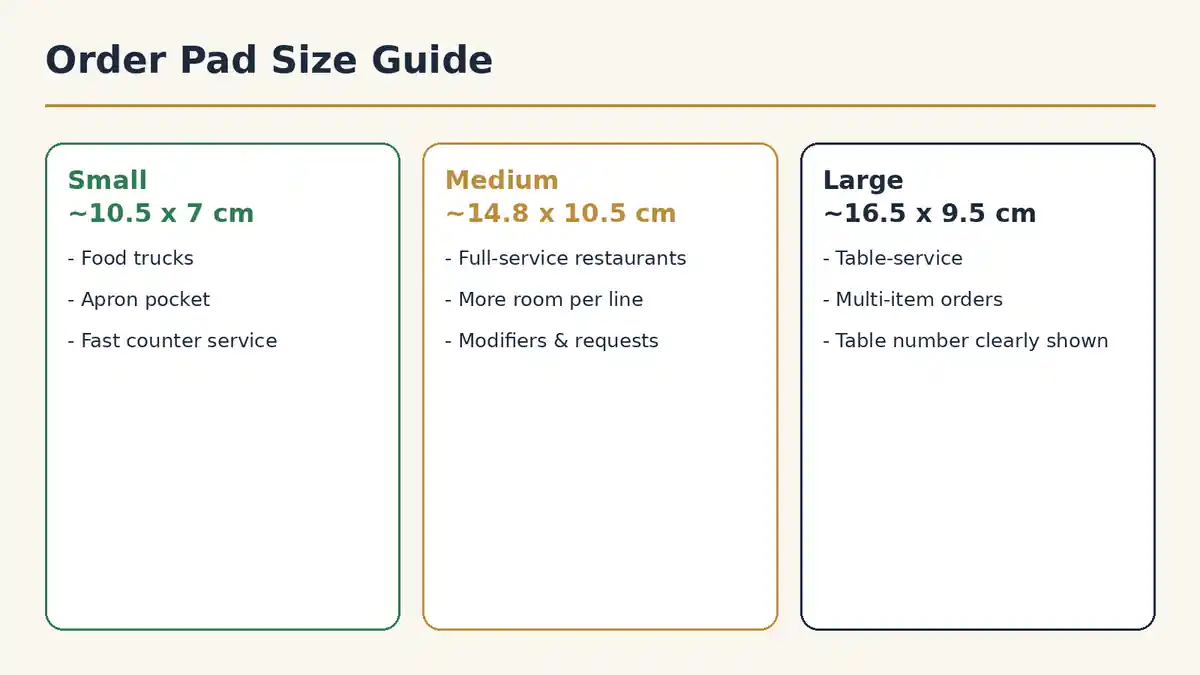
Measure your actual counter space and apron pocket before ordering, since a pad that is too large to hold one-handed slows down service during peak hours — the opposite of what an order pad is for.
How Does Carbonless (NCR) Paper Actually Work?
Carbonless order pads use chemically coated paper instead of a separate carbon sheet between copies. According to the Wikipedia entry on carbonless copy paper, the dye sits in tiny microcapsules on the back of the top sheet, and the paper underneath carries a reactive coating; pressure from a pen breaks the capsules so the dye marks every copy beneath it. That is why a server has to press firmly, especially on the last copy of a 3-part pad — the mark gets fainter with each layer.
What Should Be Pre-Printed on Every Order Ticket?
Leave blank handwriting space only for what actually changes order to order. Everything else should be printed in advance:
- Restaurant name and logo on the header, so a dropped ticket is still identifiable.
- A pre-printed sequential number, so missing or duplicate tickets are easy to spot during a busy shift.
- Labeled fields for table number, item, quantity and special instructions, laid out in the order your staff actually fills them in.
- A small total or notes line at the bottom if your kitchen staff need a running count without checking the till separately.
If you are also printing other front-of-house materials for the same season, our guide on food truck menu and price board printing for Riyadh Season vendors covers the customer-facing side of the same rush period. And if your order pad is one piece of a bigger branding refresh, our branded stationery essentials guide walks through which printed pieces to prioritize first.
Common Mistakes When Ordering Custom Order Pads
- Choosing 3 copies “just in case”: extra copies most staff never read just add friction to tearing off each ticket.
- Skipping a pre-printed number: without it, a missing ticket during a busy shift is nearly impossible to trace back.
- Picking a pad too large for the apron pocket it will actually live in: measure the pocket, not just the counter.
- Leaving no space for a table or order number: this is usually the first field a server looks for under pressure.
Checklist Before You Order
- ☐ Counted exactly how many stations need to see each order at the same time (copy count).
- ☐ Measured the counter space or apron pocket the pad needs to fit.
- ☐ Decided on pre-printed sequential numbering.
- ☐ Chosen which fields are pre-printed labels vs blank handwriting space.
- ☐ Confirmed whether tickets need Arabic, English, or both.
- ☐ Checked if this order pad matches other branded stationery you already use, like a custom notepad for back-office notes.
FAQ
Can I print my restaurant’s logo on a carbonless order pad?
Yes — the header and footer of each sheet can carry your logo and name, while the body stays blank for handwritten order details.
Do I need Arabic and English on the same order pad?
Only if your kitchen staff and front-of-house staff read different languages; otherwise a single language with clear labeled fields is faster to fill in under pressure.
How many sheets come in a standard order pad?
This depends on the supplier and pad size you choose — confirm the sheet count and copy count together before ordering, since the two decisions affect each other.
Is a 2-part or 3-part pad more expensive?
A 3-part pad generally costs more per sheet than a 2-part one because of the extra carbonless layer, so only add a third copy if a specific station actually needs it.
Bringing It Together
The right order pad is less about design and more about matching copy count and size to how your kitchen and front-of-house actually work during a rush. Get the copy count and pre-printed numbering right first, and the rest of the layout follows naturally. Browse our printing options for cafés and restaurants, request a quote, or message us on WhatsApp to get your custom order pads sized and numbered correctly.
Sources: Carbonless copy paper — Wikipedia
