
Paper Ink Blog
Printed Essentials for Optometry & Eye Clinics in Saudi Arabia

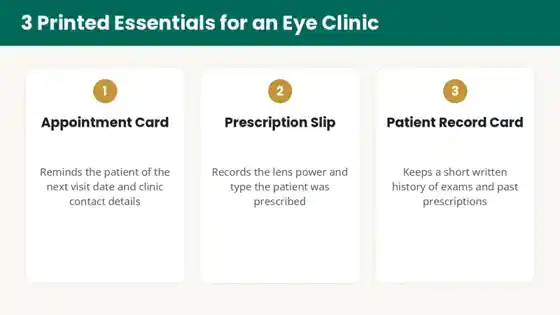
An optometry or eye clinic in Saudi Arabia needs three printed essentials to run day to day: an appointment card handed to every patient at checkout, a prescription slip recording the exact lens power prescribed, and a patient record card kept in the clinic file. None of these are optional paperwork — without them, a clinic has no reliable way to remind a patient of their next visit, no written copy of the prescription the patient can take to an optical shop, and no short written history to refer back to at the next exam.
In short: An optometry or eye clinic needs three printed essentials — an appointment card with the next visit date and contact details, a prescription slip listing the lens power prescribed, and a patient record card summarizing exam history — each printed on a material built for how it is actually carried and stored, not plain printer paper.
What Should an Optometry or Eye Clinic Actually Print?
A clinic needs more than a sign above reception. Three specific printed items cover almost every patient visit: an appointment card handed out at checkout, noting the next visit date, the clinic’s contact number, and a short reminder of what to bring; a prescription slip given after the exam, stating the lens power prescribed for each eye so the patient can take it to any optical shop; and a patient record card kept in the clinic’s own file, summarizing past exams and prescriptions so a returning patient’s history is on hand in seconds.
Each of these needs a different print decision, because each is handled differently and lives in a different place — a card carried daily in a patient’s wallet, a slip that leaves the clinic entirely in the patient’s hand, and a record card that stays filed inside the clinic itself.
Why Does an Eye Clinic Need These Printed Materials Specifically?
A patient who leaves without a written prescription slip has no way to act on it anywhere else, and that is the core reason this matters. A prescription slip is a printed record stating the lens power prescribed for each eye, so the patient can take it directly to an optical shop of their choice instead of relying on a verbal note or a memory of the numbers read out during the exam. A clinic seeing several patients a day has no reliable way to avoid mix-ups without this kind of printed, hand-over record, and a patient who loses track of their own prescription is one of the fastest ways a clinic loses a returning customer entirely.
The same logic applies to the appointment card: a visit that ends with only a verbal “come back in six months” is a reminder with no paper trail, and patients forget far more easily than clinics assume.
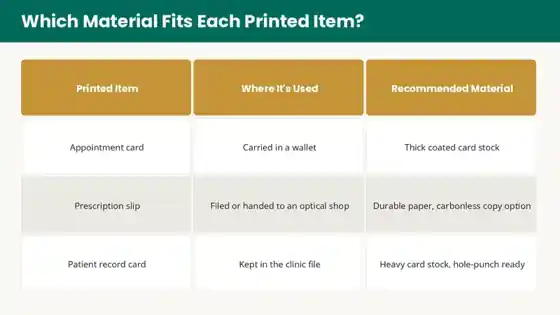
What Material Fits Each Printed Item?
| Printed Item | Where It’s Used | Recommended Material | Why |
|---|---|---|---|
| Appointment card | Carried in the patient’s wallet | Thick coated card stock, similar to a business card | Survives being carried daily for months without fading or tearing before the next visit |
| Prescription slip | Handed to the patient, often taken to an optical shop | Durable paper stock, sized to fit a standard folder | Stays legible and intact while traveling between the clinic and an optical shop |
| Patient record card | Kept inside the clinic’s own file | Heavy card stock, hole-punch ready, from tags & hangers stock options | Holds up to repeated handling and filing across many return visits |
Getting this table right the first time saves a clinic from reprinting appointment cards that faded in a wallet within weeks, or prescription slips too flimsy to survive the trip to an optical shop.
How Do Printed Essentials Build Patient Trust?
A patient handed a clear prescription slip and a proper appointment card reads the clinic as organized and professional, not a rushed five-minute exam. A printed prescription slip and a patient record card turn a single visit into part of a documented history the patient and the clinic can both refer back to, which matters more for an eye clinic than for many other practices, since a patient’s eyeglass prescription changes over time and needs an accurate record at every exam.
This kind of printed trust-building works alongside, not instead of, keeping the clinic’s Google Business Profile accurate, since many patients check a clinic’s hours and reviews online before booking a first visit. The same pattern — a numbered claim item, a durable card, and a clear written record — works for other trust-dependent small businesses too, as covered in our guide to printed essentials for a mobile phone repair shop.
What Mistakes Do Clinics Make When Printing These Materials?
Writing the prescription by hand on a plain notepad: handwriting is easy to misread later, and a patient can lose a loose sheet of paper far more easily than a proper slip.
Skipping the next-visit date on the appointment card: a card with only the clinic’s name and number gives the patient nothing to actually remember the visit by.
Printing patient record cards on thin paper: cards that tear or fade after repeated filing make a clinic’s own records unreliable within a year or two.
Using one generic card design for every printed item: an appointment card, a prescription slip, and a record card each need a different size and material, not one template stretched across all three.
Leaving out the clinic’s contact details on the prescription slip: a patient taking the slip to an optical shop loses the easiest way for that shop to call the clinic with a question.
Checklist Before Ordering Eye Clinic Printing
- Decide which of the three essentials are needed now — appointment cards, prescription slips, record cards — instead of ordering one generic design
- Choose thick coated card stock for appointment cards that will be carried in a wallet for months
- Confirm the prescription slip has clearly labeled fields for lens power per eye
- Pick heavy, hole-punch-ready stock for patient record cards kept in the clinic’s own file
- Keep the clinic’s name, phone number, and address on every printed item, not only the appointment card
- Use one consistent logo and color scheme across all three items so they read as one clinic, not three unrelated print jobs
Frequently Asked Questions
What information should an eye clinic’s prescription slip include?
The lens power prescribed for each eye, the exam date, and the clinic’s name and contact details, so the slip is useful on its own at any optical shop the patient visits.
Can an appointment card include the clinic’s logo and branding?
Yes — the logo, clinic name, and contact details can sit alongside the next-visit date, so the card also works as a small piece of branding the patient keeps in their wallet.
Does a patient record card need different material from an appointment card?
Usually yes — a record card kept inside a clinic filing system benefits from heavier, hole-punch-ready stock, while an appointment card carried daily needs a smaller, pocket-friendly card.
How long does it take to print these three items?
Turnaround depends on the quantity and material chosen, so it’s best to confirm the exact timeline directly with the print shop based on the specific order.
Bringing It Together
An optometry or eye clinic runs on a patient’s trust in records they can’t easily verify themselves, and an appointment card, a prescription slip, and a patient record card are what turn that trust into something written down and accurate — provided each is printed on a material built for how it’s actually carried and filed. To get all three printed on material that holds up to daily handling, get a quote or message us on WhatsApp.