
Paper Ink Blog
Printed Essentials for Saudi Mobile Phone Repair Shops

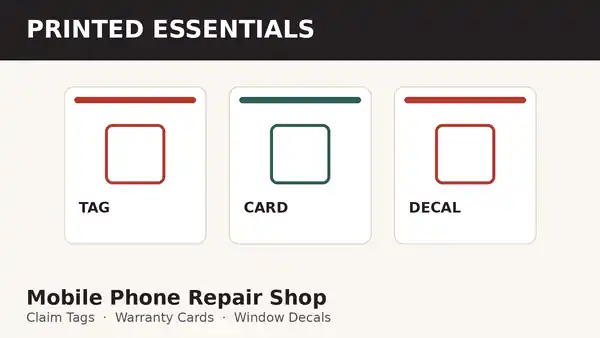
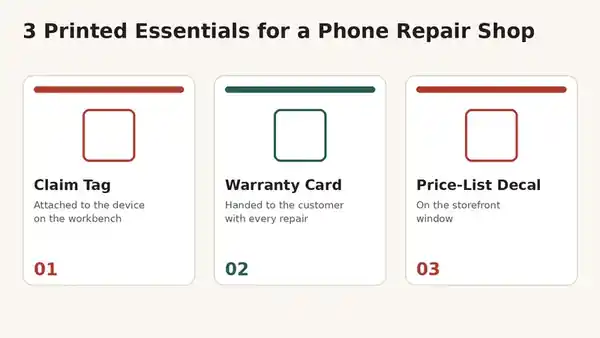
A mobile phone repair shop in Saudi Arabia needs three printed essentials to run day to day: a numbered claim tag attached to every device dropped off for repair, a warranty card handed over with every completed repair, and a price-list or service-menu window decal that works as walk-in signage. None of these are optional extras — without them, a shop has no way to match a returned phone to its owner, no written proof of the repair warranty if a part fails again, and no way for a walk-in customer to see at a glance what the shop actually fixes.
In short: A mobile phone repair shop needs three printed essentials — a numbered claim tag attached to each device, a warranty card listing the date, part replaced, and warranty period, and a price-list window decal showing core services — each printed on a material built to survive daily workshop handling, not plain office paper.
What Should a Mobile Phone Repair Shop Actually Print?
A phone repair shop needs more than a sign above the counter. Three specific printed items cover almost every daily interaction: a claim tag attached to every device left for repair, noting the device model, the reported issue, and a short reference number so it can be matched back to the right customer at pickup; a warranty card given with every completed repair, stating the date, the part replaced, and the shop’s warranty terms in writing instead of a verbal promise a customer can’t later prove; and a price-list window decal listing core services (screen replacement, battery swap, charging port repair, data transfer) so a passer-by knows what the shop offers before ever walking in.
Each of these needs a different print decision, because each is handled differently and lives in a different environment — a tag hanging off a physical device on a workshop bench, a card kept in a customer’s wallet, and a decal facing direct sun on a storefront window.
Why Does a Repair Shop Need Printed Materials Specifically?
A repair without a claim tag is one busy afternoon away from being handed to the wrong customer, and that is the core reason this matters. A numbered claim tag is a small, durable printed tag attached to a device the moment it is dropped off, recording the device, the reported fault, and a short reference such as the last digits of the IMEI (International Mobile Equipment Identity), so the shop can match any device on the bench back to its owner and ticket without relying on memory. A shop juggling several phones, tablets, and laptops on a busy day has no reliable way to do this without a tag system, and a dropped or mixed-up device is one of the fastest ways to lose a customer’s trust entirely.
The same logic applies to the warranty card: a repair without one is just a verbal disagreement waiting to happen if the replaced part fails again within weeks.
What Material Fits Each Printed Item?
| Printed Item | Where It’s Used | Recommended Material | Why |
|---|---|---|---|
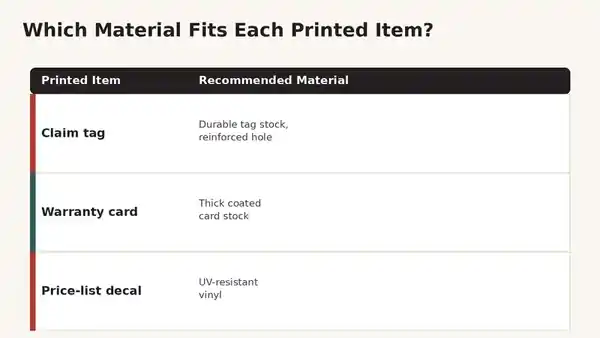
| Claim tag | Attached to the device on the workshop bench | Durable tag stock with a reinforced hole, from tags & hangers | Stays attached and legible through handling, cables, and tools on the bench |
| Warranty card | Handed to the customer, kept in a wallet | Thick coated card stock, similar to a business card | Survives being carried daily without tearing or fading before the warranty period ends |
| Price-list window decal | Storefront window, facing direct sunlight | UV-resistant vinyl, from sticker printing | Resists fading and peeling from daily sun exposure on a shop window |
Getting this table right the first time saves a shop from reprinting a batch of warranty cards that faded within a month, or a window decal that peeled after one Riyadh summer.
How Do Printed Essentials Build Customer Trust?
A customer handed a proper warranty card reads the shop as established and accountable, not a back-alley fix. A printed warranty card and a numbered claim tag turn an informal repair into a documented process the customer can actually refer back to, which matters more for a phone repair shop than almost any other trade, since the device being repaired usually holds a customer’s photos, contacts, and personal accounts.
This kind of printed trust-building works alongside, not instead of, keeping the shop’s Google Business Profile listing accurate, since many customers now check a repair shop’s reviews and hours online before ever walking in — a consistent paper trail in-store and a consistent profile online reinforce the same impression of a shop that takes the trade seriously. The same pattern — a tag, a warranty card, and clear signage — works for other trust-dependent trades too, as covered in our guide to printed essentials for a locksmith shop.
What Mistakes Do Repair Shops Make When Printing Materials?
Using a sticky note or masking tape as a claim tag: it falls off during handling, leaving a device with no link back to its owner or repair ticket.
Skipping a reference number on the tag: two similar phone models dropped off the same day are one easy mix-up away from being handed back to the wrong customer.
Printing warranty cards on plain receipt paper: it fades and tears within weeks, so the shop ends up with no real proof of the warranty terms when a customer returns with a complaint.
Printing a window decal with no UV-resistant coating: a decal that looked fine on day one fades or peels after a single hot season, making the storefront look neglected rather than professional.
Listing every possible repair on one crowded decal: a window decal readable from the street needs the 3-4 core services in large type, not a dense list nobody can read while walking past.
Checklist Before Ordering Repair Shop Printing
- Decide which of the three essentials are needed now — claim tags, warranty cards, window decal — instead of ordering one generic design
- Choose a durable tag stock with a reinforced hole for claim tags handled on the workbench
- Confirm the claim tag has space for a reference number and the reported issue, not just the customer’s name
- Pick a thick, coated card stock for warranty cards that will be carried in a wallet daily
- Pick UV-resistant vinyl for any window decal facing direct sunlight
- Keep the window decal text to the 3-4 core services, in large, readable type
Frequently Asked Questions
Can a repair shop warranty card include the shop’s logo and branding?
Yes — the logo, shop name, and contact details can be printed alongside the warranty terms and date fields, so the card also works as a small piece of branding the customer keeps.
What size works best for a claim tag?
A small tag, similar in size to a standard price or luggage tag, works best, since it needs to attach to a phone, tablet, or laptop without getting in the way during repair work.
How long does it take to print window decals and warranty cards?
Turnaround depends on the quantity and material chosen, so it’s best to confirm the exact timeline directly with the print shop based on the specific order.
Does a window decal need a different design from the warranty cards?
Usually yes in terms of size and material, but keeping the same logo, colors, and fonts across all three items makes the shop look like one consistent, established business rather than three unrelated print jobs.
Bringing It Together
A mobile phone repair shop runs on trust with devices that hold a customer’s personal data, and a numbered claim tag, a warranty card, and a clear price-list decal are what turn that trust into something a customer can actually hold and verify — provided each is printed on a material built for how it’s actually used. To get all three printed on material that holds up to daily handling and Saudi summers, get a quote or message us on WhatsApp.