
Paper Ink Blog
Glossy, Matte or Washable Sticker Paper: Which Survives Real-World Use?

Waterproof sticker paper usually handles splashes, wet hands and fridge condensation, but rarely survives soaking, scrubbing or a dishwasher. Plain glossy or matte paper fails at the first spill. For labels that get washed, chilled or left in the Saudi sun, laminated vinyl is the dependable choice. Test a sample before you print a full run.
Quick take
- “Waterproof” on a pack of sticker paper usually means water-resistant, not submersible.
- Glossy vs matte is about looks; durability comes from the material, adhesive and laminate.
- In fridges and humid heat, the adhesive tends to fail before the print does.
- Repeated washing or rubbing calls for laminated vinyl, not paper.
Waterproof vs water-resistant: what the label on the pack really means
Truly waterproof would mean a sticker could sit underwater with no damage at all. Very few printable sheets are built for that. What most products deliver is water resistance: the ink doesn’t run when it gets splashed, wiped with a damp cloth or covered in condensation. Long soaks and sponge scrubbing are a different test entirely.
A label’s real-world durability depends on three layers working together:
- Face stock: coated paper, synthetic film (polyester or polypropylene) or vinyl.
- Adhesive: permanent or removable, and how well it grips when cold or humid.
- Protection: a clear laminate or varnish over the print.
If any one layer is weak, the label fails, no matter how good the other two are.
Does glossy sticker paper hold up better than matte?
Only slightly. A glossy surface sheds droplets a little faster because it’s smoother, but standard glossy paper still wicks water in from the edges and wrinkles just like matte. Matte hides scuffs and fingerprints better and you can write on it with a pen, yet unprotected matte prints can fade faster with handling.
Rule of thumb: pick glossy or matte for the look, and pick the material and laminate for durability. For a visual comparison of finishes, see our guide to glossy, matte and spot UV sticker finishes.
Five real-world durability tests you can run at home
Print a test sheet, cut five samples and stick them on the actual surfaces you’ll use. Wait 24 hours so the adhesive can bond fully, then run the test that matches your product:
- Water test: hold the sample under a running tap, then rub it with your thumb. Does the ink smear? Do the edges swell?
- Fridge test: stick it on a plastic tub, chill it overnight, then let it sweat at room temperature. Weak adhesive shows up here.
- Heat and humidity test: leave the sample in a parked car or on a sunny windowsill. Gulf heat combined with coastal humidity quickly reveals labels that lift at the corners.
- Abrasion test: rub the label twenty times with a dry cloth, then with a damp sponge. Fading or scuffing means the print needs a laminate.
- Wash test: for lunch boxes, bottles and reusable containers, hand-wash the sample with soap several times before you even consider a dishwasher.
Take before-and-after photos. A sample that passes the test closest to your real use is worth more than any claim printed on the box.
Which sticker material survives which conditions?
| Condition | Standard glossy/matte paper | Water-resistant sticker paper | Laminated vinyl |
|---|---|---|---|
| Splashes, wet hands | Poor | Good | Excellent |
| Fridge and condensation | Wrinkles, falls off | Fair, depends on adhesive | Very good |
| Heat and humidity | Edges lift | Fair | Very good |
| Daily rubbing | Fades fast | Fair | Excellent |
| Repeated hand-washing | Not suitable | Limited | Very good |
| Dishwasher | Not suitable | Not recommended | Test first |
This is a general guide based on typical use. Actual results depend on the adhesive and print quality, which is exactly why testing matters.
When paper is enough, and when you need vinyl
Paper (even standard) is fine when:
- The label sits inside a carton or on a dry bag that never meets water.
- The product is used up within days, like bakery boxes or dessert packaging.
- You need to write on the label by hand; matte paper is ideal here.
Water-resistant sticker paper works when:
- The product sees light moisture or brief condensation, such as honey jars or sauces kept in a kitchen.
- You print small batches yourself and can reprint as needed.
Choose vinyl when:
- The item is chilled or washed: cold drinks, reusable food containers, kids’ bottles.
- The label lives outdoors or in direct sun: shop windows, delivery vehicles, outdoor tables.
- It carries your logo and needs to look good for months.
For more on why labels peel in Gulf conditions, read why product labels peel in heat and humidity.
Washable stickers in practice
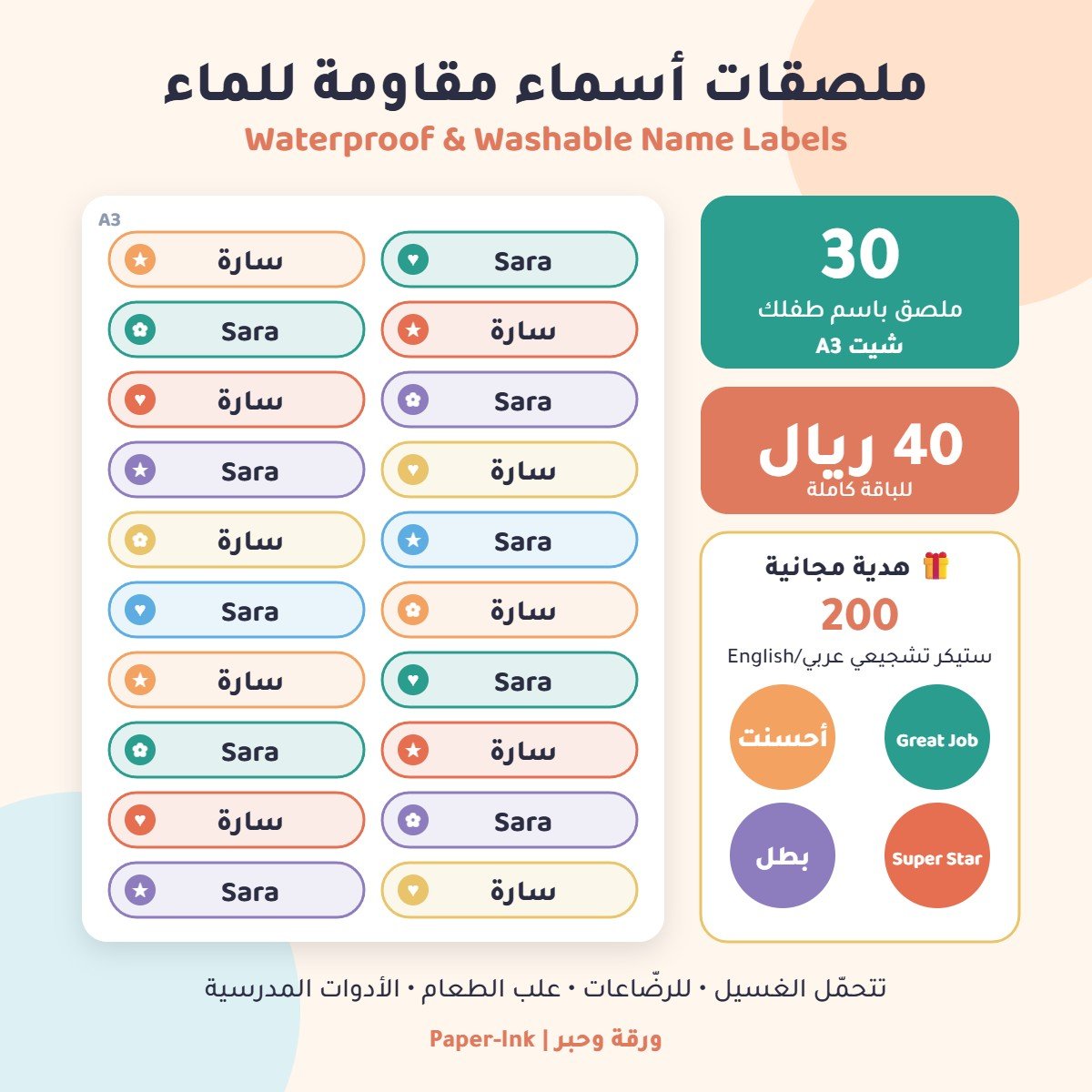
The clearest example of a truly washable sticker is a kids’ name label for school. It goes on bottles, lunch boxes and water flasks that get washed almost every day, so only water-resistant vinyl with a strong adhesive holds up, and it should be left a full day before the first wash. Our guide to kids’ name labels for school covers the details.
Another example is a QR review sticker on a glass door or checkout counter. It’s touched, wiped with cleaning spray and exposed to sunlight, so it needs laminated vinyl that protects the colors.
Tips to make any sticker last longer
- Clean the surface of oil and dust, and dry it completely before applying.
- Press from the center outward to push out air bubbles.
- Never apply to a cold or sweating surface; label first, then refrigerate.
- Round the corners slightly where you can; sharp corners lift first.
- If you print at home, let the ink dry fully before laminating.
Still deciding which paper to buy in the first place? Our companion printer sticker paper buying guide for Saudi Arabia covers sizes, formats and quantities.
FAQ
Is waterproof sticker paper actually waterproof?
Usually not in the strict sense. Most waterproof sticker paper is designed to resist splashes, condensation and damp hands rather than long soaking. If your product will be submerged or washed daily, choose laminated vinyl instead, and test a sample on the real container before ordering a full quantity.
Is glossy sticker paper more water-resistant than matte?
The difference is small. Glossy surfaces shed droplets slightly faster, but standard glossy paper still absorbs water through its edges just like matte. Durability is set by the face stock, adhesive and laminate; choosing glossy or matte is mainly a decision about appearance and writability.
Why do labels fall off in the fridge even when the print looks fine?
Because the problem is usually the adhesive, not the ink. Cold temperatures reduce the tack of some adhesives, and condensation forms under the edges when products come out of the fridge. Use an adhesive suited to cold storage and apply labels to dry, room-temperature surfaces before chilling.
Can I make paper stickers waterproof?
You can improve them with a clear self-adhesive laminate or a protective spray, which shields the ink from splashes and rubbing. The core is still paper, though, so it won’t survive repeated washing or long fridge storage. For demanding uses, vinyl remains the safer choice.
How do I know a sticker will work before ordering in bulk?
Get or print a sample and apply it to the actual packaging, not a different surface. Run the test that mirrors real use, whether that is water, fridge, sun or washing. Wait a day after applying, then check the ink, edges and adhesive separately.
The bottom line
Waterproof sticker paper is a solid step up from plain paper, but it isn’t the answer to every condition. Identify the toughest situation your label will face and test for it before you order. If your product needs vinyl that stands up to water and heat, browse waterproof custom sticker printing from Paper-Ink and request a free digital proof before printing.
