

Paper Ink Blog
Why Product Labels Peel in Heat and Humidity (And How to Stop It)


Short answer: product labels peel in heat and humidity because the adhesive softens or the paper backing absorbs moisture and swells, breaking the bond with the surface. The fix is matching the label material and adhesive to the actual conditions the product will face, not just picking the cheapest sticker stock.
If you sell food, drinks, cosmetics, or anything shipped through a hot warehouse or a humid coastal city, a peeling label is not a cosmetic problem. It is a trust problem: a customer holding a jar with a curling, unreadable label questions the product inside it too.
What Actually Makes a Label Peel?
A product label is only as durable as the weakest link between three layers: the face material, the adhesive, and the surface it sits on.
Most paper-based labels use adhesives designed for stable, dry, indoor conditions. When temperature rises above roughly 40°C, common in Saudi warehouses and delivery vans during summer, the adhesive softens and loses grip strength. When humidity is high, especially in coastal cities like Jeddah or Dammam, uncoated paper labels absorb moisture from the air, expand slightly, and lift at the corners first. Condensation from refrigerated or frozen packaging makes this worse, since the surface itself becomes wet exactly where the label needs to hold.
Which Label Material Actually Resists Heat and Humidity?
The short version: vinyl outperforms paper for anything exposed to heat, humidity, or condensation. Paper labels are fine for short shelf life, indoor-only products, or one-time use. Vinyl labels, like Paper-Ink’s professional vinyl sticker printing, do not absorb moisture the way uncoated paper does, so the material itself stays stable even when the room or the product surface does not.
For irregular container shapes, bottles, or curved jars, die-cut sticker printing cut to the exact outline of your label design also helps the label sit flat against the surface, instead of leaving straight edges that catch moisture and start peeling first.
| Condition | Paper Label | Vinyl Label |
|---|---|---|
| High heat (warehouse, delivery van) | Adhesive softens, edges lift | Stays flexible, adhesive holds |
| High humidity (coastal storage) | Absorbs moisture, warps | Resists moisture, no warping |
| Refrigerated / frozen packaging | Condensation lifts corners fast | Handles surface moisture well |
| Short-term indoor use only | Acceptable, lower cost | Not necessary, higher cost than needed |

How Do You Choose the Right Adhesive for Your Product?
An adhesive is only “strong” for the specific surface and condition it was built for — the same label stock can hold perfectly on cardboard and fail within days on cold, wet glass. This is why the pressure-sensitive adhesive used on most product labels comes in several formulations, not one universal type.
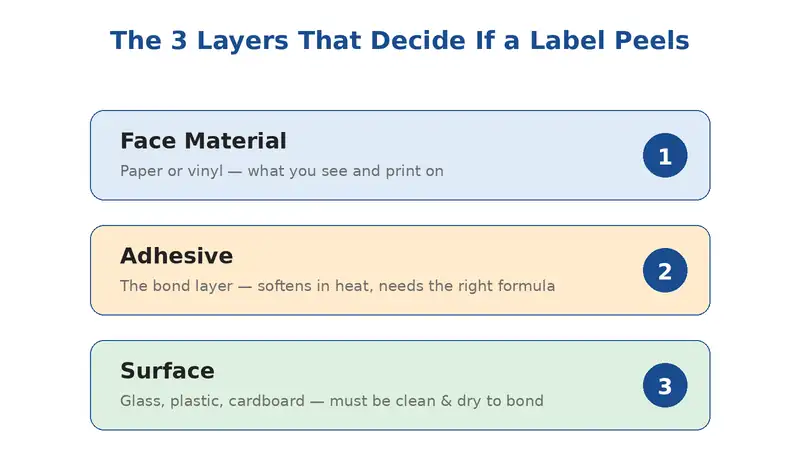
For most Saudi small businesses, the practical decision is simpler than adhesive chemistry: match the label to where the product actually lives. Dry-goods packaging stored indoors can usually get by with a standard adhesive. Anything refrigerated, exported, or displayed outdoors needs a stronger, moisture-resistant adhesive from day one, because reprinting an entire batch after labels start peeling costs more than choosing the right material the first time.
This is also where the sizing and shape of the label matter more than most sellers expect. A label cut slightly larger than the surface it sits on tends to catch on packaging edges during handling, and every catch is a chance for a corner to start lifting. Browsing Paper-Ink’s full sticker printing options before finalizing artwork makes it easier to size the label correctly the first time, rather than adjusting after a batch already looks wrong on the shelf.
Common Mistakes Businesses Make With Product Labels
Choosing the cheapest label stock without checking storage conditions. A label that looks identical in a store display can behave completely differently after a week in a hot delivery van.
Applying labels to a wet or oily surface. Even the strongest adhesive fails if the surface itself was not clean and dry when the label was applied.
Ignoring humidity, not just temperature. Businesses plan for heat because it is obvious, but relative humidity damage is often the actual cause of peeling and gets misdiagnosed as “bad glue.”
Skipping a small test batch before a full print run. Testing 10-20 labels on the real product in real storage conditions catches a bad material choice before it becomes a full-batch problem.
Quick Checklist Before You Order Product Labels
- Identified the actual storage and delivery conditions (indoor only, refrigerated, exported, outdoor display)
- Chose vinyl over paper for anything facing heat, humidity, or condensation
- Confirmed the surface material the label will stick to (glass, plastic, cardboard)
- Ran a small test batch before committing to a full print run
- Checked that label size and shape match the container, not a generic template
- Confirmed turnaround time fits your actual shipping or launch date
Frequently Asked Questions
Why do my product labels peel off after a few days?
The most common cause is a mismatch between the adhesive and the real storage conditions — heat softens the bond, and humidity makes uncoated paper absorb moisture and lift at the edges.
What is the best material for waterproof product labels?
Vinyl generally performs better than paper for anything exposed to moisture, heat, or condensation, since it does not absorb water the way uncoated paper does.
Do I need waterproof labels if my product is only sold indoors?
Not necessarily. If storage and display stay dry and climate-controlled, a standard paper label can be enough, which is also the lower-cost option.
Can I test a label material before ordering a full batch?
Yes — a small test batch applied to the actual product in its real storage conditions is the most reliable way to confirm a material choice before committing to a larger order.
Bringing It Together
A peeling label is rarely bad luck. It is almost always a mismatch between the material you chose and the conditions your product actually lives in. Matching vinyl to heat and humidity, testing before a full run, and confirming the surface your label sticks to will solve most peeling problems before they start. If you are packaging a product for Saudi heat, humid storage, or cold-chain delivery, request a quote for packaging stickers built for the conditions your product will actually face, or reach us directly on WhatsApp.




5 thoughts on “Why Product Labels Peel in Heat and Humidity (And How to Stop It)”