
Paper Ink Blog
Paper vs Vinyl Stickers: How to Choose the Right Material for Your Packaging

Quick answer: Paper vs vinyl stickers is a question that comes up with almost every packaging order. For dry boxes and bags, compare paper stickers first. For packs that face moisture or repeated handling, compare vinyl or another film material. However, the material name alone does not settle the choice. You need a label whose face, adhesive, print and finish all suit your use, without paying for extras you do not need. If you are new to the process, first read how custom stickers are printed and cut.
The key question is not “which type is strongest?” Instead, ask three things. Which pack will the sticker go on? What will it face after application? And how long must it stay clear and attached?
Paper vs vinyl stickers: four things not to mix up
1. Face material: the layer that carries your design
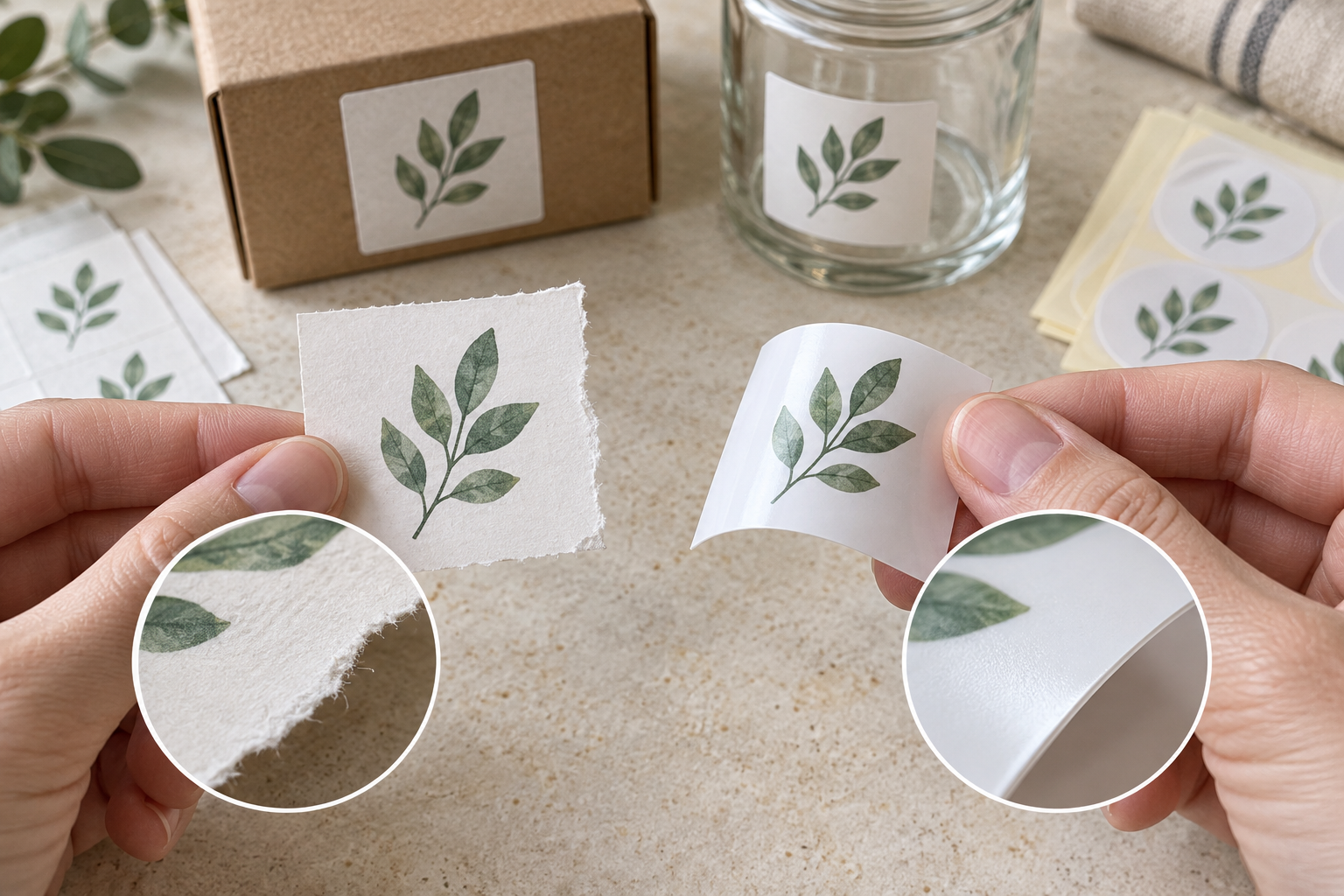
A paper sticker has a paper face. Paper comes coated or uncoated, in many textures, so “paper” is not a single specification. Vinyl, on the other hand, is only one type of plastic film. Not every label marked “plastic” is vinyl, because polypropylene and polyethylene films also exist. Their properties differ by product, as Avery and HERMA explain.
Therefore, ask for the exact material name, especially when you compare two price quotes. The words “plastic sticker” alone do not tell you what you will receive.
2. Adhesive: what holds the label on the pack
Choosing a paper or vinyl face does not decide the adhesive. Label material makers offer different formulas for different surfaces. Some are permanent, some are removable, and some target special conditions. In addition, initial tack differs from final bond strength, as the HERMA adhesives guide shows.
Tell the printer whether the pack is carton, glass or a specific plastic. Also say whether the surface is rough, coated or curved. Finally, state whether the label should stay forever or come off later.
3. Printing: will colors and details stay clear?
A material may survive the use while the print itself needs extra protection. Avery’s durable label materials guide notes that print method and ink compatibility affect performance, not only the material. For that reason, judge the finished printed label, not a blank sheet.
4. Finish: protection for the face, not a substitute for adhesive
Varnish is a liquid coating. Lamination, in contrast, adds an extra film layer over the printed face. The look can shift between matte and gloss depending on the finish. A protective layer does not automatically mean the adhesive suits your pack, and it does not make the label safe for every kind of water exposure. See Avery’s varnish vs laminate comparison for details.
Also note the backing paper. The liner you peel the sticker from is not necessarily the printed material. It has its own job, separate from the face and the adhesive, as the HERMA release liner page explains.
When are paper stickers enough in the paper vs vinyl stickers choice?
Paper deserves a fair comparison when the sticker carries a logo or a thank-you message on dry packaging. It also fits when the sticker does not need more durability than the real use cycle demands. Avery’s guide points to paper for bags, shipping boxes and gift wrapping, and it ties the choice to exposure and handling.
Start with this case: a gift box prepared in a dry place, where the label only shows your brand until delivery. Our starting recommendation is to compare paper first. Then check how well it holds on the box surface and how good it looks. Do not upgrade the material just because the name “vinyl” sounds better.
A dry box does not mean every paper and every adhesive will work. Some cartons are rougher, and some packs are coated. For this reason, the real surface remains part of the decision. Paper itself is not a cheap-looking choice either. Paper materials come with different looks and textures, so choose the finish that serves your brand.
When should you compare vinyl or film?
The paper vs vinyl stickers decision tilts toward film when there is a clear need. Examples include repeated moisture, rubbing and handling, or a pack that needs a flexible label while in use. For squeezable packs, ask how the label behaves when the pack is pressed, not only how it looks when the pack is empty and still. If the product may meet oils or creams, say so clearly. Water resistance does not replace checking resistance to the substance that may reach the label.
Is a vinyl sticker waterproof?
Do not rely on the word vinyl to prove full performance. Light condensation, spray and full immersion are different conditions. The problem may lie in the face, the print or the adhesion. Avery separates waterproof from water-resistant labels and stresses testing the label on the real pack.
Likewise, do not assume freezer, heat or sun suitability from water resistance alone. Name the condition you need and ask for the specification, because these are separate requirements.
Paper vs vinyl stickers by pack and use
The list below is an initial guide to organize the decision. It is not a guarantee of suitability.
- Cardboard gift box, dry, light handling: check carton roughness and edge hold. Compare paper first, and do not upgrade without need.
- Paper bag, dry, may bend: keep the label away from folds and check adhesive compatibility. A suitable paper is a reasonable first candidate.
- Plastic or glossy-coated bag, flexible surface: check the real surface material and label flexibility. Compare a film that follows the bag’s movement.
- Glass jar with a dry product: check curvature, edge hold and look. Compare paper and film by shape, cost and handling.
- Cold drink bottle or cup: chilling is followed by condensation. Compare a film with a documented specification for these conditions.
- Squeezable plastic pack: repeated pressure, and possibly cream or oil. Ask for a specification for this use, not just “vinyl”.
Test the size on the real pack
Before you approve, place a sample at real size on the pack. Check whether it sits on a flat part or crosses a fold or curve. This is a shape and size check, not an adhesive test.
Two examples: why one logo can need two specifications
These examples are hypothetical. They are not customer stories or test results.
A gift shop in Riyadh needs a logo sticker on a dry carton box. The suggested path is to compare a paper material suited to the box surface first. Then evaluate edge hold and design clarity. If it meets the need at a lower cost, there is no business reason to reject it just because it is paper.
A drinks brand in Jeddah needs labels on bottles that come out of the fridge. The suggested path differs. Describe the chilling and condensation cycle to the printer, confirm the face, adhesive and print specification, and test a sample on the actual bottle. Success on a gift box does not prove success on this bottle.
The lesson of these paper vs vinyl stickers examples is simple. The same logo can need two different specifications because the use is different.
Are paper vs vinyl stickers cheaper? Compare two equal quotes
When you price paper vs vinyl stickers, do not compare only a “paper price” with a “vinyl price”. Fix the size, quantity, number of designs, cutting and finish. Then ask what each quote includes. If two options meet the required use, compare their real totals and pick the one that suits your budget. However, if the cheaper option needs reprinting or replacement during use, the purchase price alone is not enough to decide.
How to test your choice before ordering a quantity
Before you commit to paper vs vinyl stickers in bulk, ask whether a sample or trial batch is possible and what it costs. A digital proof helps you review the design, but it is not an adhesion or water test.
- Use the real pack. Prepare samples on the same type and surface you will use, and note the test conditions.
- Keep size and conditions equal. Record the material, adhesive and finish of each sample, and follow the supplier’s instructions for application and waiting time.
- Test only the real use cycle. For a chilled pack, test chilling and condensation. Do not test a water spray and then treat it as proof of immersion.
- Record what happened. Watch the edges, bubbles or wrinkles, and print clarity after handling. Keep a photo and the specification name, and go back to the supplier if a problem appears.
Prepare your Paper Ink order with a clear specification
You can start from our sticker printing options, or review the custom vinyl sticker product, which has fields for size, quantity, PDF upload, finish and cutting. Choose the setup after confirming that it matches your use. For packs used in other trades, see also bilingual labels for pet shops and vet clinics.
Send the pack type and usage conditions, then request a quote. The right start is not the most expensive sticker. It is a specification that actually serves your product.
Top 10 practical tips for choosing paper vs vinyl stickers
- Define the pack environment first. Write whether the pack is dry, wet or cold before comparing prices.
- Choose paper for dry boxes. A dry surface with light handling does not usually need a costlier material.
- Choose vinyl for moisture. Cold or washed packs need a face that does not absorb water.
- Do not judge by gloss. Gloss describes appearance, not water resistance.
- Ask for the actual material name. Write “coated paper” or “white vinyl” instead of “plastic” alone.
- Check the adhesive with the surface. Glass, plastic and carton react differently to the same adhesive.
- Test a sample on your real pack. Leave it a day in the fridge and a day in the heat before ordering a quantity.
- Request a free digital proof. We review size and colors with you before printing.
- Compare two equal quotes. Fix size, quantity and finish first.
- Prepare the file carefully. A good design works on any material, so check your artwork before sending.
Latest updates as of October 2026
Here is what changed for paper vs vinyl stickers recently. Avery updated its durable label materials guide on 21 October 2026, according to the page. The guide compares paper, polypropylene and vinyl for water and oil resistance. It ranks paper as the least durable and vinyl as the most durable for outdoor use.
In addition, a comparison guide from 4over4 says plain paper wrinkles when wet. Vinyl and clear films, meanwhile, keep their grip under condensation and cold. So testing on your own pack matters more than any general rule.
We found no new confirmed regulation about sticker materials themselves. If the pack holds food, check the Saudi Food and Drug Authority food labeling pages before printing.
Frequently asked questions about paper vs vinyl stickers
Is every plastic sticker vinyl?
No. Vinyl is one film material, and other plastics exist for labels. Ask for the actual material name instead of the word “plastic”.
If a sticker comes on a sheet, is it paper?
No. A sheet describes how stickers are supplied, not the printed face. The backing liner is also separate from the label material.
Does laminating paper turn it into vinyl?
No. Lamination is a protective layer over a paper face and does not change the original face. Judge the whole build before comparing.
Is a glossy sticker always water-resistant?
No. Gloss describes appearance and is not a test of water performance. Ask about the material, print, adhesive and exposure.
Does vinyl peel off a pack without residue?
It depends on the adhesive and the surface, not on the word “vinyl”. Confirm the use and removal conditions before ordering.
Which suits a cold cup better: paper or vinyl?
Vinyl is usually more suitable, because condensation damages plain paper. Ask for a sample and test it on the same cup.
How long do production and delivery take?
Most orders are prepared in 3 to 5 working days, then shipped within 24 to 72 hours. Shipping is free for orders of SAR 250 or more.
