
Paper Ink Blog
Home Printing vs a Print Shop: Compare Cost and Small Quantities

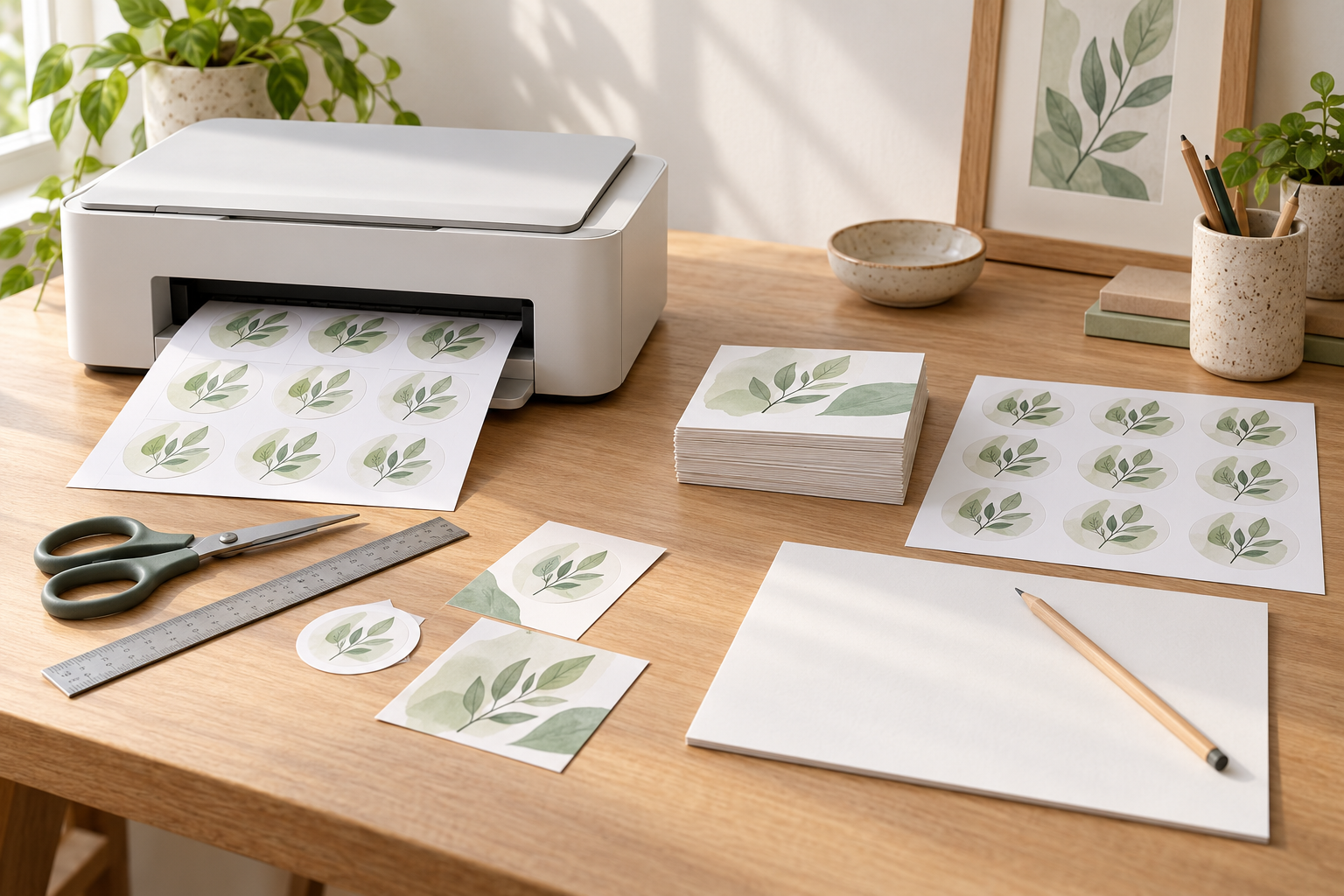
Quick answer: Choosing between home printing vs a professional print shop depends on your specification, the real cost, the time and the number of usable pieces. It does not depend on a fixed cut-off such as 30 or 50 pieces. Test what you need with home printing, then count the paper, ink, cutting, labor and rejected pieces. After that, compare the result with a print shop quote for the same size, material, finish and quantity. For the production basics, read how custom stickers are printed and cut.
When is home printing a suitable choice?
Home printing can help you test a card size, a logo position or how a text reads before you approve the design. It may also meet a repeated need if your printer, material, cutting method and available time suit the result you want. We do not judge by the small number alone, and we do not assume that every printed item a customer sees must be made the same way.
Home printing works best when you define the goal of the sample. Testing shape and size is different from testing a production material, an adhesive and performance. A sample on plain paper may help you choose a card position, but it does not prove how another material handles water, heat or transport. Use materials and settings that your printer’s maker states, and check compatibility before you buy a sheet only because it is called “sticker paper”.
When is it worth requesting a print shop quote?
Start the comparison with a print shop when preparation time starts to affect your business. Do the same when you need a material, a cut or a finish that your current route cannot provide, or when the order repeats enough to justify organized reprints. These are reasons to request a quote and review the result. They are not automatic proof that a print shop is cheaper or faster.
Decide what you want to improve: readability, size, cut consistency, turnaround time or print material. Send a sample or a clear description of the problem instead of asking for “higher quality” with no standard. See our loyalty cards guide for cafés and restaurants for an example of choosing priorities before you add more items.
Calculate the cost of a usable piece in home printing
- Home route: materials and ink actually used, setup, printing, cutting and assembly time, rejected pieces and the cost of attempts, and any operating or equipment costs tied to your decision.
- Print shop quote: size, material, quantity and print method, design, preparation, cutting and finishing included, the count and delivery unit, and what arrives ready to use, plus delivery and any extra lines fixed in the quote.
For home printing, divide the total of the items you compare by the number of usable pieces, and state what you included in the calculation. Do not compare the price of a ream of paper with the price of a finished order, and do not count an included service twice. If you are weighing a new printer purchase, keep that decision separate from the cost of a batch of materials for a printer you already own.
A lower unit price does not mean the biggest quantity is best. You may pay now for stock beyond your need, and the text or logo may change before you use it. Separate the amount you pay from the cost of the pieces you use in the period, and record leftover usable stock without treating it as a sure saving or a sure loss.
Home printing or a print shop: do print shops accept small quantities?
Check the product, the pricing unit and the options available. At Paper Ink, the custom cards form shows quantities starting from 100 pieces, and the kraft bag shows 100, 200, 500 and 1,000 pieces at the time of review. These lists do not prove that 20 pieces of either product can be made, or a single minimum for the rest of the site.
If your quantity does not appear, ask whether it is possible, what the specification is and what it costs. A missing option does not prove it is impossible, but it needs confirmation before you add it to a budget or promise a delivery date. Do not assume the smallest commercial quantity is a sample, or that every print shop offers a single free piece or one for a fixed fee.
Three units not to mix up: card, sheet and package
- Card: the unit is one piece. Confirm the count, the faces, the size and the copies.
- Sticker sheet: the unit is a sheet that holds pieces. Confirm the number of sheets and the stickers inside each sheet.
- Packaging package: the unit is a set of different items. Confirm the name, count and size of each component.
On an A6 sticker sheet, the design size, the cut and the approved gaps affect how the pieces are laid out. A need for 50 stickers does not automatically equal 50 sheets or an available purchase quantity. Review our sticker sheet printing guide before you approve the cost. Likewise, the name of a custom package does not say how many customer orders it covers. An order may need two stickers and one card, so stock coverage differs between the two items.
Home printing color, cutting and material: set an acceptance standard
Review color on the intended material and with an agreed approval method. No one can guarantee an exact match between every printer, material or batch just from the words “professional printing”, and a color system alone does not guarantee the result. Keep a reference of the version, material and finish, and confirm what you need when you reorder.
For cut shapes, ask for a review of the cut path, the borders and the tolerance accepted for the specification. Do not treat machine cutting as a guarantee of zero variation. The name “vinyl”, or a gloss or matte look, does not prove resistance to water, scratches or every weather condition. State the surface, the time and the way it will be used, then confirm the material, print and adhesive together. For a closer look, read our guide to paper vs vinyl stickers.
Prepare a full specification even for a small home printing batch
Write the size, material, faces, cut, finish and count per design. A small quantity does not make an unclear file print-ready. Review your sticker file preparation, and confirm the delivery format and the services you need, including design or edits if the file is not ready.
If you want a trial, define the question it will answer: size, color, performance or supply method. Ask what is available, what it costs and what limits apply to the judgment. Do not turn a limited test into a certificate for every use condition, and do not carry the success of a sample from one material to another.
Timing and reordering are part of the home printing comparison
Separate file review from production and delivery. No general lead time of two or three days suits every item and quantity, so get a date for the actual order after the specification is confirmed. Home preparation time is measured by your own trial, and a supplier’s time comes from its quote. Do not assume a smaller quantity arrives faster.
Keep the file name, the approved version, the material balance and your trial notes. If the material, surface or size changes, review suitability again. Use ordering, file and shipping guidelines to collect these details before you approve the next batch.
Top 10 practical tips for choosing home printing vs a print shop
These ten steps settle your decision with numbers instead of impressions. Apply them before you buy paper or request a quote.
- Count usable pieces only. Divide the total cost by accepted pieces, not by what came out of the printer.
- Record the real ink use. Print ten copies and estimate what was used.
- Test the paper on your own printer first. Inkjet and laser printers give different results.
- Set the acceptance standard in advance. Write the accepted color and cut precision before printing, so your judgment does not shift with your mood.
- Count your time in hours. Hand cutting, preparation and reprints are real costs in home printing.
- Compare with the same specification. Ask the print shop for the same size, material and finish.
- Avoid the common sticker paper mistakes. Review printing mistakes on sticker paper before you buy a large quantity.
- Use the same file in both routes. Prepare a print-shop-ready file from the start, so a later move is easy.
- Request a free digital proof. We send it before printing and help you prepare the file if you need.
- Plan to reorder. Save the final specification and calculate the sticker cost per product so repeating the order is easy.
Latest updates as of October 2026
We found no new confirmed Saudi update that changes the comparison between home printing and a print shop. For that reason, we mention only what we verified about ink cost and cartridge locking.
A report from Castle Ink, published in October 2026, says many HP and Epson printers may block non-original cartridges. Its author sells compatible cartridges and discloses that commercial interest, so read the report with care.
HP settled a class action in March 2025 without admitting fault, and users kept the option to decline firmware updates that include this lock. This is what The Register reported. Before you buy, ask the seller about the cartridge policy of the model you want, and include it in your home printing calculation.
Frequently asked questions about home printing vs a print shop
Is there a fixed number that makes a print shop cheaper?
No. Calculate your specification, materials, labor and usable count, then compare them with a real quote.
Can I print a test piece?
Ask about the sample service and its terms for the specific product. The smallest quantity shown in a form does not prove it.
Should I choose the cheapest per piece?
Review the amount you pay, the quantity you will use, the date and the result you need, not the unit price alone.
Is home printing suitable for a small business?
Yes, for tests and very small quantities, provided you count ink, paper, time and rejected pieces. When orders repeat, review our guide to stickers for small businesses.
How long does a print shop take to fulfill an order?
Most orders take 3 to 5 working days to produce, then shipping takes 24 to 72 hours.
Do you ship outside Saudi Arabia?
Yes. We deliver within Saudi Arabia and to Gulf countries. Shipping is free for orders of SAR 250 or more.
Can I see the design before printing?
Yes, we send a free digital proof before printing. Contact us on WhatsApp to review your file.
Browse and request a quote
Browse the stickers and paper prints at Paper Ink, then request a quote with a clear counting unit. Choose the route whose specification, cost and timing you can confirm for your project.
