
Paper Ink Blog
Presentation Folder Printing: Pocket Layout, Paper Weight, and Branding Guide

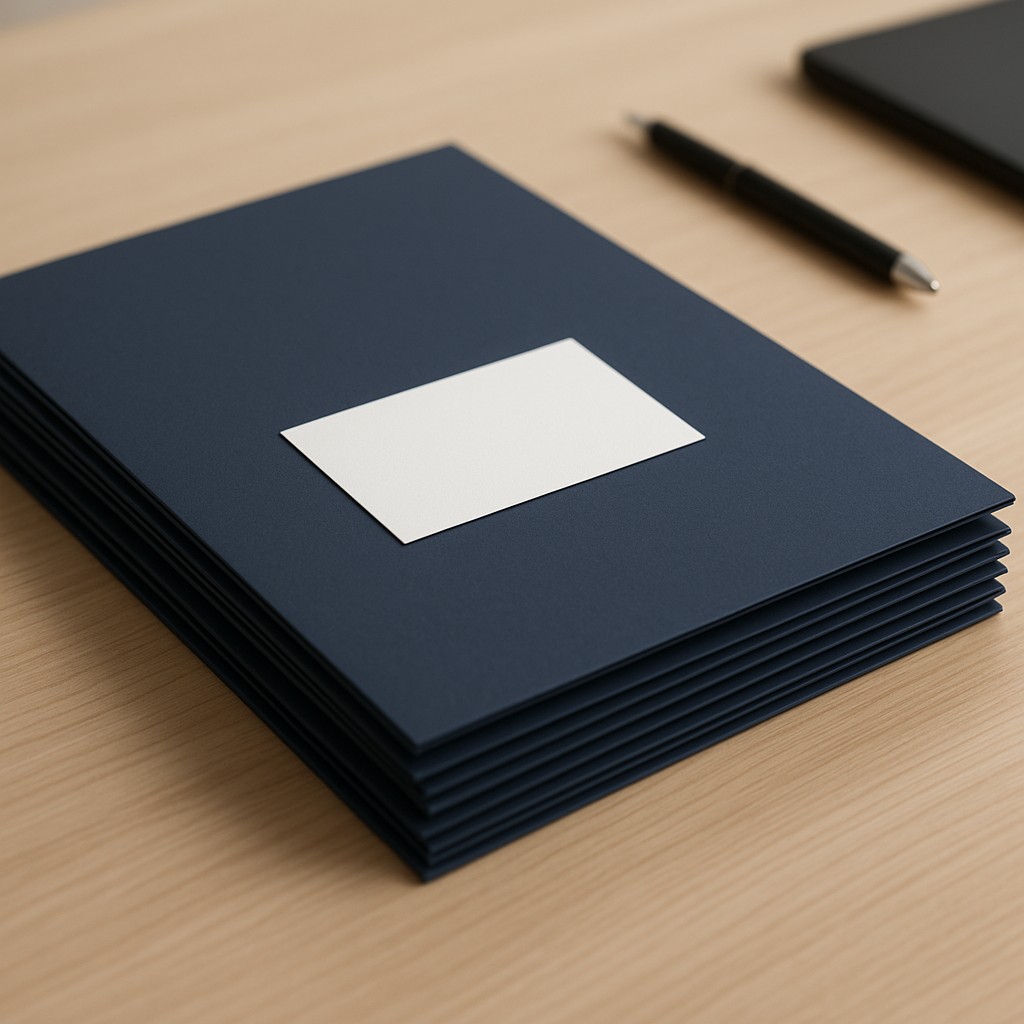
The fastest way to choose a presentation folder for your business is to decide the pocket layout first, then the paper weight, then the finish — in that order. Most companies do it backward: they pick a nice cover design, then discover the folder cannot actually hold what they need (a full proposal, a business card, a USB drive) without bending or spilling documents. This guide walks through the pocket layouts that work for real office use, what weight of stock holds its shape, and how to brand the folder so it looks consistent with the rest of your stationery.
Start with what the folder needs to hold
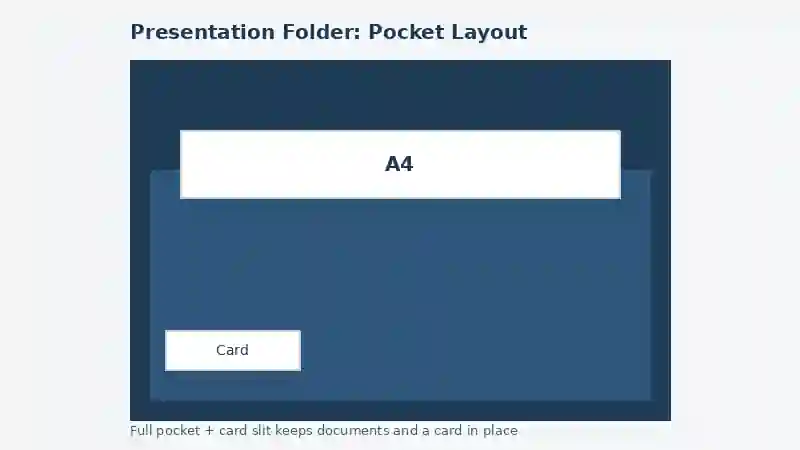
Before any design decision, list exactly what goes inside: a bound proposal, loose A4 sheets, a business card, a small brochure, or a USB stick. A folder built for one sheet of paper looks identical to a folder built for a 20-page proposal until it is actually loaded — then the thin one bulges, the spine curls, and the business card slides out. The diagram below shows the layout that handles the most common office scenario: a full A4 document plus a business card, held by two separate features rather than one oversized pocket.
Pocket layouts that actually hold up in daily use
There are three layouts worth considering for business stationery, and each solves a different problem:
- Full inner pocket: a single pocket covering most of the inside panel, best for loose sheets or a stapled handout. Simple to produce and the most affordable option.
- Full pocket with a card slit: adds a short diagonal or straight cut sized for a standard business card, so the card does not slide around loose with the documents. This is the layout most client-facing teams should default to.
- Double pocket (left and right): separates document categories — for example, a contract on one side and supporting appendices on the other — useful for legal, finance, or any proposal with multiple distinct documents.
If your folder needs to carry a matching letterhead or branded insert sheets, align the pocket layout with how those inserts are folded, so nothing has to be creased awkwardly to fit.
Paper weight: where folders actually fail
A folder that looks sharp in a product photo can still fail in the hand if the stock is too light. For a cover that gets handled repeatedly — passed across a meeting table, carried in a bag — anything under 300 GSM tends to show wear within a few uses: corners round off, the spine loses its crease, and the surface scuffs. For internal-use folders that mostly sit in a drawer, a lighter stock around 250 GSM is a reasonable cost-saving choice. The rule of thumb: match the paper weight to how often the folder will actually be handled, not to how it looks on day one.
Quick reference: folder specs by use case
| Use case | Recommended pocket layout | Recommended weight | Finish |
|---|---|---|---|
| Client proposals, sales meetings | Full pocket with card slit | 300-350 GSM | Matte lamination or soft-touch |
| Legal or financial documents | Double pocket | 300 GSM | Matte lamination |
| Internal reports, drawer storage | Full inner pocket | 230-250 GSM | Uncoated or light gloss |
| Conference or event handouts | Full pocket with card slit | 250-300 GSM | Gloss lamination |
Branding the folder without overdesigning it
A presentation folder is one of the few pieces of stationery a client or partner physically holds for several minutes while flipping through documents, so it is worth getting the branding basics right rather than filling the cover with text. Keep the front panel to a logo, a single tagline at most, and enough white space that the cover does not compete with whatever is printed on the inside pockets or inserts. Matching the folder’s color and finish to your branded stationery essentials — business cards, letterhead, envelopes — matters more for a cohesive look than any single design flourish on the folder itself.
For companies printing in volume across several stationery pieces at once, requesting one combined quote that covers folders, cards, and letterhead together, rather than ordering each item separately, is the more efficient way to keep paper stock, color profile, and lamination consistent across every piece a client sees. As a general cross-reference, see Wikipedia’s overview of paper weight and density standards for how GSM measurements translate across different paper types.
Common mistakes when ordering presentation folders
- Choosing the cover design before the pocket layout: this almost always results in reordering once the folder is tested with actual documents.
- Skipping a physical proof: color on a screen and color on laminated stock can differ noticeably, especially with dark or metallic brand colors.
- Underestimating lamination drying and cutting time: laminated folders with die-cut pockets need more production time than a simple printed sheet — order at least two to three weeks ahead of a launch or event.
- Using a card slit sized for one card orientation only: if your team hands out cards in both portrait and landscape formats, a single fixed slit size can be too tight for one of them.
- Forgetting the spine width when the folder needs to close fully loaded: a folder designed flat may not close properly once a thick proposal and a brochure are both inside.
Checklist before sending your folder to print
- Confirm exactly what documents, cards, or inserts the folder needs to hold.
- Choose the pocket layout based on that content, not on the cover design alone.
- Match paper weight to how frequently the folder will be handled.
- Request a physical proof and check it under natural light before full production.
- Align the folder’s branding with your existing business card, letterhead, and envelope stock.
- Confirm production and lamination lead time, with a buffer for any last-minute design changes.
Frequently asked questions
What paper weight should a presentation folder be? For folders that get handled repeatedly in client meetings, 300-350 GSM holds its shape and resists wear; lighter stock around 230-250 GSM is fine for folders that mostly stay in a drawer or filing cabinet.
Can a presentation folder hold both documents and a business card securely? Yes, with the right layout — a full pocket combined with a dedicated card slit keeps the card from sliding loose among the papers, which a single oversized pocket cannot do reliably.
How long does it take to produce branded presentation folders? Simple printed folders can be ready in a few days, but folders with lamination, die-cut pockets, or foil branding need more lead time — plan for two to three weeks ahead of any event or launch date.
Should the folder match our business cards and letterhead exactly? It should match closely in color, paper finish, and logo placement; exact material matching is not required, but a visibly different shade or finish between pieces is what makes a stationery set look unplanned.
Bringing it together
A presentation folder earns its cost when it survives real use: documents stay flat, the business card stays put, and the branding reads clearly without shouting. Decide the pocket layout around what the folder actually needs to carry, choose a paper weight that matches how often it will be handled, and keep the branding consistent with the rest of your stationery. Request a quote or reach us directly on WhatsApp to spec out branded presentation folders for your next batch of client meetings.
