
Paper Ink Blog
Ghost Kitchen Branding in Saudi Arabia: Stickers and Packaging for Multiple Delivery-Only Brands

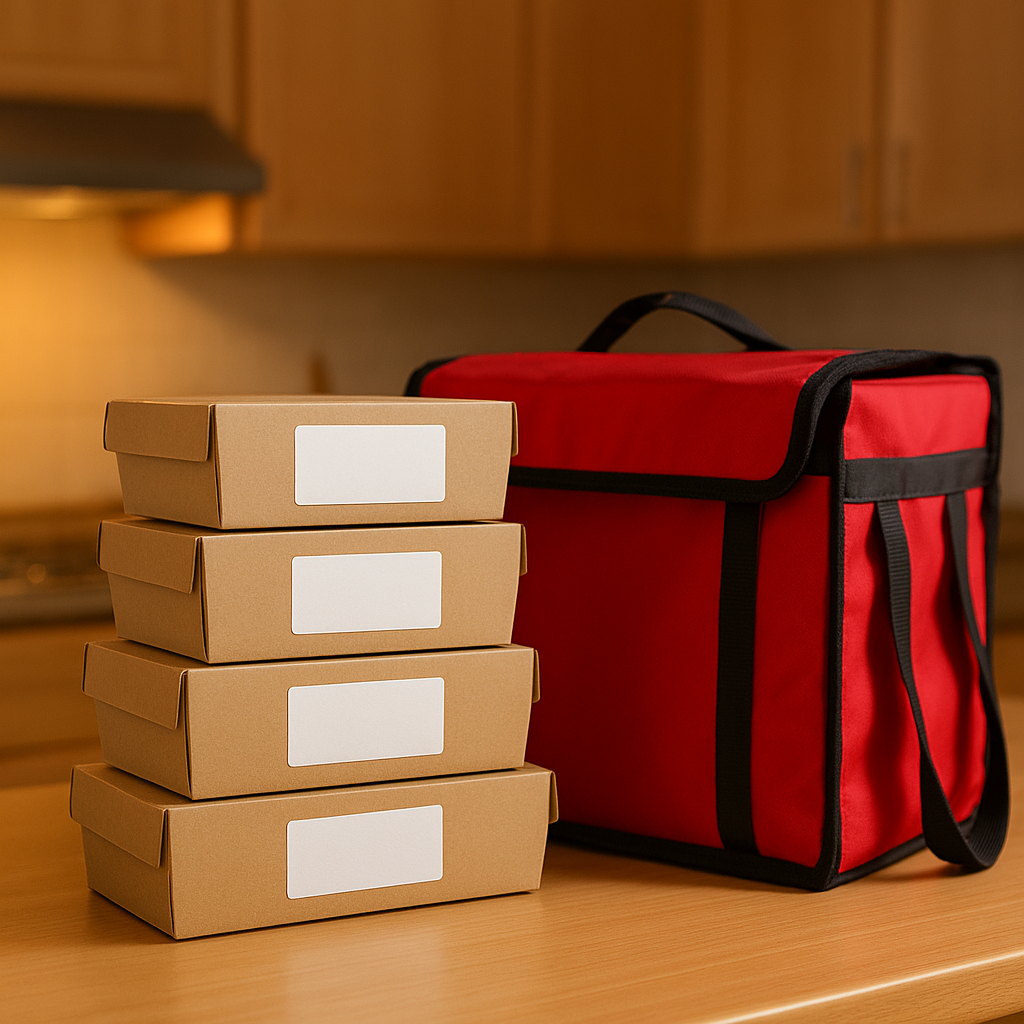
Short answer: a ghost kitchen running several delivery-only restaurant brands from one physical kitchen needs a separate, clearly branded sticker and packaging set for each virtual brand, not one shared design, or customers on delivery apps will not be able to tell which brand actually cooked their order.
Saudi Arabia’s delivery-only kitchen sector has grown from a handful of hidden operators into branded, multi-concept businesses running several virtual restaurants out of one address in Riyadh or Jeddah. Most of what gets written about this model online covers launch cost or kitchen equipment. Almost nothing covers the packaging problem that shows up the moment a kitchen goes from one brand to three.
What exactly is a ghost kitchen, and why does branding get complicated fast?
A ghost kitchen, also called a cloud kitchen or dark kitchen, prepares food for delivery or pickup only, with no dining room and no walk-in customers. One kitchen commonly runs two to five separate virtual restaurant brands, each with its own menu, logo, and listing on delivery apps, to reach more customer segments without opening more physical locations.
The complication starts the moment two brands share a kitchen but use the same plain box or the same generic sticker. A customer who ordered from “Brand A” on an app sees a box with no matching logo, or worse, a sticker from “Brand B” left over from the last print run.
Why one shared sticker design hurts multi-brand ghost kitchens
Each virtual brand lives entirely on its delivery-app listing photos and reviews. If the packaging a customer receives does not match those photos, the mismatch reads as a mix-up or even as a fake listing, and it shows up in reviews and refund requests rather than in repeat orders.
Shared packaging also makes it harder to track which brand a complaint belongs to, since kitchen staff juggling several active orders at once rely on the sticker or label to route the right bag to the right rider.
What should change between brands, and what can stay the same?
Not everything needs a brand-specific reprint. The table below separates what must be unique per brand from what a kitchen can safely keep standardized to control cost.
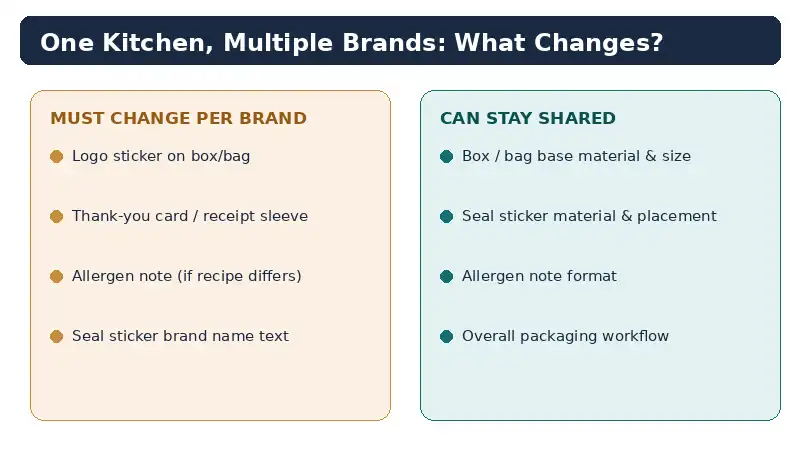
| Packaging element | Must change per brand | Can stay shared across the kitchen |
|---|---|---|
| Logo sticker on the box or bag | Yes | No |
| Box or bag base material and size | No | Yes |
| Tamper-evident seal sticker | Text only (brand name) | Material and placement |
| Allergen or ingredient note | Yes, if the recipe differs | Format only |
| Thank-you card or receipt sleeve | Yes | No |
Keeping the base box or bag standardized across brands while changing only the sticker is usually the lowest-cost way to give every virtual brand a distinct, recognizable identity.
Security seal stickers and tamper-evidence for delivery orders
A visible seal sticker across the box or bag opening shows the customer the order was not opened between the kitchen and their door, and it is one of the simplest ways any delivery-only brand builds trust before the customer has tasted anything.
For a multi-brand kitchen, the seal sticker also doubles as a quick visual check for kitchen staff: if the seal design does not match the order ticket in front of them, the wrong bag is about to go out the door.
Common Mistakes Multi-Brand Kitchens Make With Packaging
- Printing one generic box for every brand: and relying on a handwritten brand name, which looks unfinished next to a polished delivery-app listing photo.
- Skipping a visible seal sticker: to save a small per-order cost, then losing far more to refund disputes over “tampered” or “already opened” claims.
- Reusing leftover stickers from a retired brand: on a new concept because the roll is not finished yet, confusing both staff and customers.
- Letting the delivery-app photo drift from the real packaging: after a reprint changes the color or logo size, which triggers “not as described” complaints.
- Treating all brands as one reorder cycle: instead of tracking sticker stock per brand, which leads to one brand running out mid-shift while another has excess.
Checklist Before Your Next Reprint
- [ ] Each active virtual brand has its own logo sticker design and color set
- [ ] A tamper-evident seal sticker is placed on every order, not just some
- [ ] Sticker and box stock are tracked separately per brand, not as one shared pile
- [ ] The physical packaging matches the brand’s current delivery-app photos
- [ ] Allergen or ingredient notes are updated whenever a recipe changes
- [ ] A small reprint buffer exists so no brand runs out mid-service
For the base packaging itself, Paper-Ink’s restaurant and café packaging stickers guide covers material choices that hold up to steam and oil, and the guide to choosing sticker materials by industry is a useful next step once you know how many brand-specific designs you need. If some of your order volume also ships through a marketplace rather than a delivery app, the packaging and barcode checklist for marketplace fulfillment covers that separate set of requirements.
FAQ
Can one kitchen legally and practically run multiple restaurant brands in Saudi Arabia?
Yes, this is the standard ghost kitchen model; each brand still needs its own delivery-app listing, menu, and, for packaging purposes, its own visual identity.
Do ghost kitchen brands need different packaging, or just different stickers?
In most cases a different sticker on a shared box or bag is enough; a full packaging change is only needed if portion sizes or box dimensions genuinely differ between brands.
How many sticker designs does a typical multi-brand kitchen need?
One core logo sticker per active brand at minimum, plus a shared or brand-specific seal sticker, so a three-brand kitchen usually manages at least three to four sticker designs in active rotation.
What packaging material holds up best for multi-brand delivery orders?
Grease- and moisture-resistant stock is the safer default across brands, since food type and delivery time vary, and a sticker or box that fails on one brand’s menu items fails on all of them.
Bringing It Together
A ghost kitchen’s biggest branding risk is not the logo design itself, it is letting packaging quietly stay generic while the delivery-app listings look fully built out. Fixing that gap is usually a sticker reprint, not a kitchen redesign. If you are ready to give each of your virtual brands its own packaging identity, browse Paper-Ink’s restaurant and café packaging category, then request a quote or reach us directly on WhatsApp.
