

Paper Ink Blog
Bilingual Wedding Invitations in Saudi Arabia: Laying Out Arabic and English on One Card

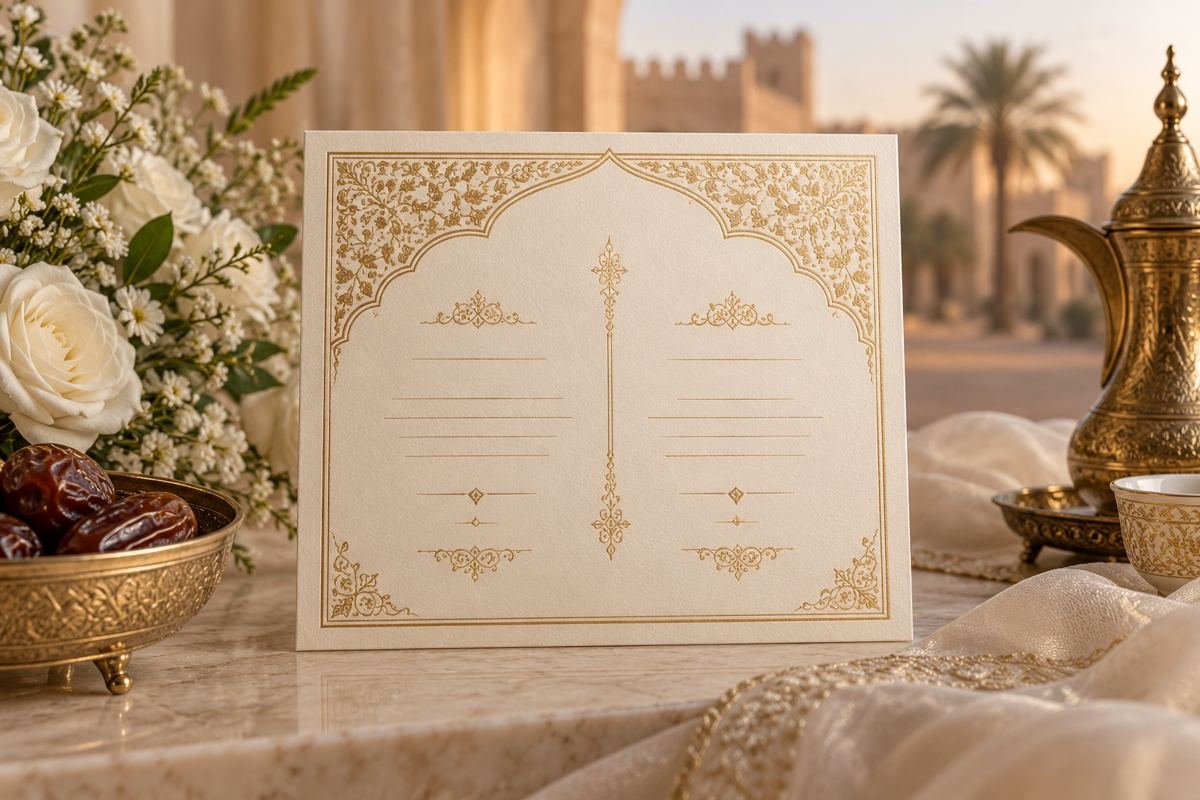
Short answer: for a bilingual Arabic–English wedding invitation, put each language in its own block rather than mixing them line by line. Either print Arabic on the front and English on the back, or split one side into two columns with Arabic on the right and English on the left. Keep names, dates and the venue identical in both versions, and have a native reader of each language check the proof.
Weddings in Saudi Arabia increasingly bring together families from different countries, colleagues from international workplaces and relatives who read English more easily than Arabic, or the reverse. A bilingual card avoids printing two separate runs, but only if the layout respects how each script reads.
Which bilingual layout works best?
| Layout | How it works | Best for |
|---|---|---|
| Front and back | Arabic on one side, English on the other | Formal invitations with longer text |
| Two columns | Arabic right, English left, aligned row by row | Short invitations where guests compare details |
| Folded card | Arabic on the right inner page, English on the left | Invitations with a verse or opening line |
| Main card + insert | Arabic main card with a small English insert card | Mostly Arabic guest lists with a few English readers |
Why mixing the two languages line by line causes problems
Arabic reads right to left and English left to right. When both appear in the same line or paragraph, punctuation, numbers and names can flip position, a problem the W3C explains in its guidance on right-to-left text direction. On a printed card the same issue appears as dates shown in the wrong order or a bracket that faces the wrong way. Separate blocks avoid it entirely. The same principle applies to product packaging, as covered in our guide to bilingual Arabic–English labels.
Getting names, dates and venue right in both languages
- Names: agree on one English spelling for each name before design starts and use it everywhere, including on thank-you cards later.
- Dates: include the Hijri and Gregorian dates in Arabic, and at least the Gregorian date and weekday in English.
- Venue: write the venue name exactly as it appears on maps in each language, and add one QR code that works for both.
- Time: use a clock time in English even if the Arabic version says “after Isha prayer”, so international guests know when to arrive.
Choosing fonts that sit well together
Pick an Arabic typeface first, then an English typeface with similar weight and contrast. A delicate Arabic calligraphic font next to a heavy English sans serif makes one language look like an afterthought. Keep the English slightly smaller in size, because Latin letters appear larger than Arabic at the same point size.
Proofing a bilingual invitation
- Ask one native Arabic reader and one fluent English reader to check the free digital proof separately.
- Compare every date, time and name between the two versions line by line.
- Scan the QR code from two different phones.
- Check the folded or back side in the proof, not only the front.
If you are also preparing favours, our wedding and event favour packaging guide covers matching labels and boxes, and our thank-you card wording ideas help with the follow-up cards.
Do you need a designer for a bilingual card?
Not necessarily, but bilingual layouts are where design help pays off most. Paper-Ink offers design and file preparation, so you can send both texts and we arrange them so each language reads naturally.
Frequently asked questions
Should Arabic or English come first on a bilingual wedding invitation?
In Saudi Arabia, Arabic usually comes first or on the front, with English on the back or in the left column.
Can I print both languages on one side?
Yes, in two separate columns aligned row by row. Avoid mixing both languages in the same line.
Which date format should the English version use?
The weekday plus the Gregorian date written out in full, such as “Thursday, 12 November 2026”, avoids confusion between day-month and month-day formats.
Do I need two separate print runs?
No. A front-and-back or two-column layout puts both languages on one card in a single run.
Will I see the card before it is printed?
Yes. You receive a free digital proof and printing starts only after you approve it.
Start your bilingual invitation
Send both texts and your guest count on WhatsApp and we will reply with a free digital proof. Orders of SAR 250 or more ship free anywhere in Saudi Arabia.
