
Paper Ink Blog
Pediatric Dental Clinic Printing: The 3 Printed Essentials Every Practice Needs

The printed essentials a pediatric dental clinic in Saudi Arabia actually needs are a parent consent card, a reward sticker card for the child, and a printed appointment reminder card — and each one needs a different stock and size to survive how it’s actually used. Most clinics default to printing all three the same way a general clinic prints its paperwork, which is why the reward card tears in a school bag within a week and the consent copy never makes it back to the file.
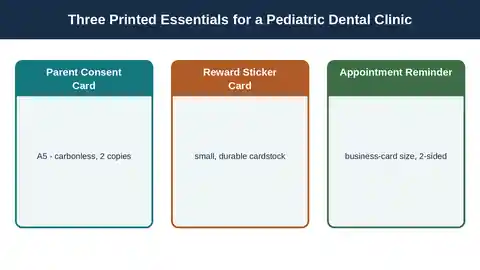
A pediatric dental clinic’s three core printed items are: a parent consent card (A5, carbonless duplicate so a signed copy stays with the clinic and one goes home), a reward sticker card for the child (small, durable cardstock with a stamp or sticker grid), and an appointment reminder card (business-card size, printed two-sided for Arabic and English).
Why does a pediatric dental clinic need printed items when most records are digital?
Most Saudi dental clinics now run on a digital patient management system, yet three specific moments still work better on paper, even for a tech-forward pediatric practice. A parent physically signing a consent card before a procedure on their child carries a different weight than tapping a screen, and many parents expect it. A reward card the child can hold, stamp and carry home does something a digital notification cannot: it turns a dental visit into something the child looks forward to rather than dreads. And a reminder card taped to the fridge survives a missed text message.
None of this replaces the clinic’s digital system — it works alongside it, at the three points where a physical object does a job a screen does not.
Section summary: paper still earns its place at three specific moments — signing, rewarding the child, and the reminder that survives a missed notification.
What printed essentials does a pediatric dental clinic actually need?
Three items cover almost everything a small to mid-sized pediatric dental clinic needs at the front desk, and each does a different job:
| Item | When it’s used | Why it matters |
|---|---|---|
| Parent consent card | Before any procedure beyond a routine check-up | Documents that a parent understood and approved the procedure in writing, kept in the child’s file |
| Reward sticker card | After a check-up or procedure, handed to the child | Builds a positive association with the visit and gives staff an easy, low-cost way to end every appointment well |
| Appointment reminder card | At the end of every visit, for the next booking | Cuts missed follow-ups, especially for multi-visit treatments like fillings or space maintainers |
Section summary: the consent card documents the decision, the reward card shapes the child’s experience, and the reminder card protects the next visit.
What material and size actually work for each item?
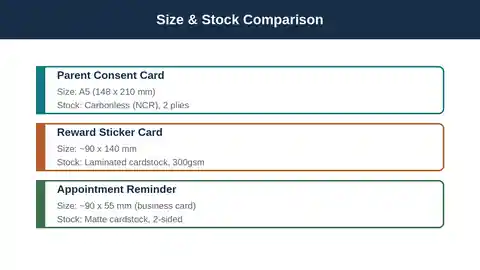
The most common mistake is printing the consent card as a single plain sheet, when it should be a two-layer carbonless (NCR) card so a signed copy stays in the clinic’s file and the parent keeps a copy for their own records, without anyone needing to photocopy it by hand.
The reward sticker card needs to survive being handled by a child, stuffed in a backpack, or carried home in a small hand — a lightweight laminated finish on heavier cardstock holds up far better than plain uncoated paper, and this is where real waterproof, child-safe stickers help: Paper-Ink’s own waterproof name labels for kids bundle already ships with 200 free motivational stickers in Arabic and English, which many pediatric clinics reuse directly on a reward card.
The appointment reminder card works best close to standard business-card size so it fits a wallet or a parent’s phone case, similar to the format used in Paper-Ink’s custom printed small square cards. For clinics serving both Arabic- and English-speaking families, printing one language per side reads far more clearly than squeezing both into one column.
Section summary: carbonless stock for consent, durable laminated cardstock for the reward card, and business-card sizing for the reminder.
How is this different from what a general clinic prints?
A general medical or dental clinic typically prints an appointment book and a prescription pad for routine visit logging and medication records. A pediatric dental practice needs those too in many cases, but its front-desk paperwork adds something a general clinic’s forms don’t cover: a consent card written for a parent making a decision on a child’s behalf, and a reward system built specifically around keeping a young patient calm and cooperative across repeat visits. These are genuinely different documents serving a different moment in the visit, not a relabeled version of the same form.
Section summary: a general clinic’s appointment book and a pediatric dental clinic’s consent and reward cards solve two different problems, even inside the same broader healthcare-printing category.
Common mistakes clinics make with these printed items
- Printing the consent card as a single copy: staff end up photocopying every signed form by hand, which adds up fast across a busy week.
- Using plain, uncoated paper for the reward card: it tears or smudges before the child even gets home.
- Cramming Arabic and English onto the same narrow column: it becomes hard to read for a parent who only reads one of the two languages.
- Making the reward card too small to hold a full stamp or sticker grid: kids lose interest in a card that fills up in one visit.
- Skipping a small test batch: ordering a large run before checking that the sticker grid size actually matches the stickers you plan to use wastes the whole batch.
Quick checklist before you print these items
- ☐ Chose carbonless duplicate stock for the parent consent card, not a single-copy sheet.
- ☐ Reviewed the consent wording with the clinic’s licensed dentist before the final print run.
- ☐ Sized the reward card to hold a real stamp or sticker grid, not just a logo.
- ☐ Picked a durable, laminated-feel cardstock for the reward card.
- ☐ Printed the reminder card close to business-card size so it fits a wallet.
- ☐ Ordered a small test batch before committing to a full print run.
Frequently Asked Questions About Pediatric Dental Clinic Printing
Is a written parent consent card actually necessary?
Documenting a parent’s written approval before any procedure beyond a routine check-up is standard risk-management practice in healthcare settings, and Saudi Arabia’s Ministry of Health publishes its own dental management forms page. The final wording should still be reviewed and approved by the clinic’s licensed dentist.
How many copies of the consent card should be printed?
At least two, through carbonless duplicate stock: one copy stays in the clinic’s file, and the parent keeps the other.
Can the reward card use real stickers instead of a stamp?
Yes — many clinics print a card with a sticker grid and use ready waterproof stickers, which avoids the ink-smudging issues a rubber stamp can cause on lighter cardstock.
Should the reminder card be bilingual?
Printing Arabic on one side and English on the other reads more clearly than combining both languages in a single narrow column, especially for parents who read only one of the two.
Bringing it together
A pediatric dental clinic only needs three printed items to cover its front desk well: a parent consent card, a reward card for the child, and an appointment reminder card — each on the right stock for how it’s actually handled. Paper-Ink can print all three for a Saudi pediatric dental clinic, including reusing its ready-made kids’ sticker bundle for the reward card. Request a quote from Paper-Ink or message directly on WhatsApp.
Further reading: Pediatric dentistry (Wikipedia) and the Saudi Ministry of Health’s dental management forms page.
