

Paper Ink Blog
Padel Club Membership Cards and Scorecards for Saudi Padel Clubs


Short answer: A padel club in Saudi Arabia needs two printed essentials beyond signage: a durable membership or access card (PVC-style cardstock, optionally with NFC for tap-in check-in) and a simple carbonless scorecard pad players can mark court-side without a phone. Both should carry the club’s colors and logo from day one, because padel players photograph and share everything.
Padel has gone from a niche racket sport to one of the fastest-growing activities in the Gulf in the span of a couple of years. Saudi Arabia is now described as Asia’s leading country for padel courts, with national tournaments carrying prize pools in the millions of riyals and new clubs opening in Riyadh, Jeddah, and the Eastern Province. Every new club that opens needs the same basic printed kit before its first member walks in, and almost none of the general “membership card printing” guides available online are written with a padel club’s actual day-to-day in mind.
Quick definition: Padel is a racket sport played in doubles on an enclosed court roughly a third the size of a tennis court, combining elements of tennis and squash.
Why padel clubs need their own printed system
A gym’s loyalty punch card or a generic membership template doesn’t fit how a padel club actually runs. Members book courts in advance through an app, check in at a front desk or turnstile, and often play in a league with a running score that has to be visible to both teams on court — not just logged on a phone that someone forgets to charge. That means a padel club’s printed needs split into two distinct products with different materials, not one generic “club card.”

Membership and access cards
Most Saudi padel clubs sell monthly or seasonal memberships, and a physical card still matters even in an app-first world, because it’s what a member hands over at the front desk or taps against a reader. A standard coated cardstock card works for a basic membership tier, but clubs running a tap-in gate or app-linked check-in increasingly ask for a hybrid NFC card, where a small chip is embedded inside a printed paper or PVC-style card so members tap in without pulling out their phone. This is the same production used for hotel-style access cards, where a chip is embedded during the printing process rather than added afterward.
Scorecards and match record pads
Padel is almost always played as doubles, and a running score across sets gets confusing without something physical court-side, especially in league play where results need to be signed and handed to the front desk. A carbonless (NCR) pad — the same multi-copy, color-separated paper used for receipt books — lets a referee or player write the score once and keep a duplicate for the club’s records, without anyone needing a phone or a laptop at the net. The same copy-and-color logic is used in carbonless invoice and receipt books, just adapted here for a running score instead of a line-item total.
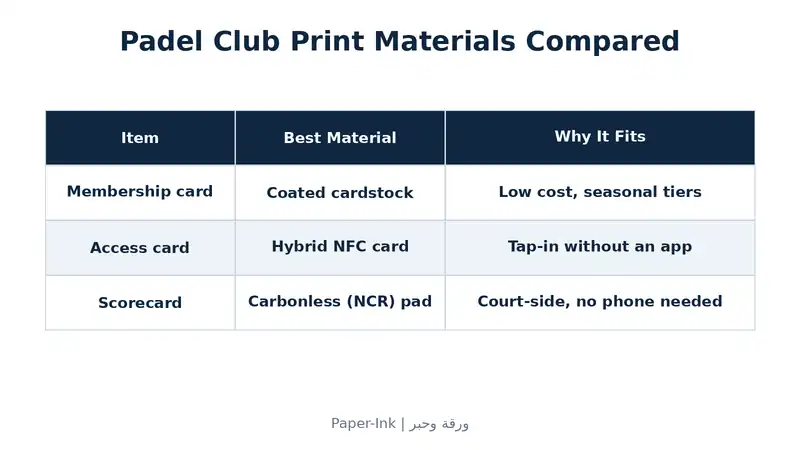
| Item | Best material | Why it fits a padel club |
|---|---|---|
| Basic membership card | Coated cardstock, single or double-sided | Low cost for a seasonal or trial membership tier |
| Access/check-in card | Hybrid NFC card | Tap-in at a gate or front desk without an app open |
| Match scorecard | Carbonless (NCR) pad, 2–3 copies | Court-side use with no phone or signal needed |
Branding that actually gets used
Padel’s social-media culture means members photograph scoreboards, cards, and court walls constantly, so the design on a membership card or scorecard header is effectively free marketing every time it’s shown on a story or a feed. A custom sticker sheet with the club’s logo, used on water bottles, racket bags, or welcome kits for new members, extends that same branding beyond the card itself — browse our sticker sheet category to see the format clubs and cafés use for retention, not just decoration.
Common mistakes
Printing a generic gym membership template. A padel club’s check-in flow, league scoring, and social sharing habits are different from a regular gym, and a template built for weightlifting memberships looks and functions wrong.
Skipping the NFC option to save cost upfront. Clubs that start with a plain card and add NFC check-in later usually end up reprinting the entire batch instead of planning for it from the first order.
Using thin paper for scorecards. A single-ply scorecard tears or smudges mid-match; a carbonless pad with at least two copies survives a full match and gives both teams a record.
Changing the club’s color scheme after the first print run. Because scorecards and cards appear in nearly every social post, a mid-season color or logo change means two inconsistent sets of printed material in circulation at once.
Checklist before you order
- Decide whether access cards need NFC/tap-in or a simple printed card is enough for now.
- Confirm your club’s logo and color palette are final before the first print run.
- Choose a carbonless scorecard with at least two copies for match records.
- Order a small test batch of cards to check the material feel before a full run.
- Review a free digital proof before final printing.
- Plan matching sticker sheets for welcome kits or retail items if you sell branded merchandise.
Frequently asked questions
Do padel clubs in Saudi Arabia really need physical membership cards if check-in is through an app?
Many still do, because a physical card works as a backup when a phone is dead or offline, and it’s handed over at the front desk for day-pass or guest visits that aren’t always tied to an account.
What’s the difference between a regular card and an NFC membership card?
A regular card is printed stock with no electronics; an NFC card has a small chip embedded during production so it can be tapped against a reader for instant check-in, the same technology used in hybrid business cards.
Can a scorecard be reprinted mid-season if we change our logo?
Yes, but it means two different scorecards will circulate until the old stock runs out, so it’s worth finalizing the design before the first print order rather than after matches have started.
How fast can a Saudi padel club get its first batch of cards and scorecards?
Most orders are ready in 3 to 5 working days after the design is approved, with delivery in 24 to 72 hours, and shipping is free across Saudi Arabia for orders of 250 SAR or more.
Bringing it together
A padel club’s printed kit is smaller than it looks: a membership or access card members actually carry, and a scorecard built for the court, not a desk. Get both right from the club’s opening day, since padel’s social-sharing culture means every card and scorecard becomes part of the club’s brand the moment it’s photographed. Request a quote from Paper-Ink, browse our business cards category for card options, or reach us on WhatsApp to get your club’s cards and scorecards printed.
