
Paper Ink Blog
Dry Cleaning Claim Tickets: A Printing Guide for Saudi Laundries

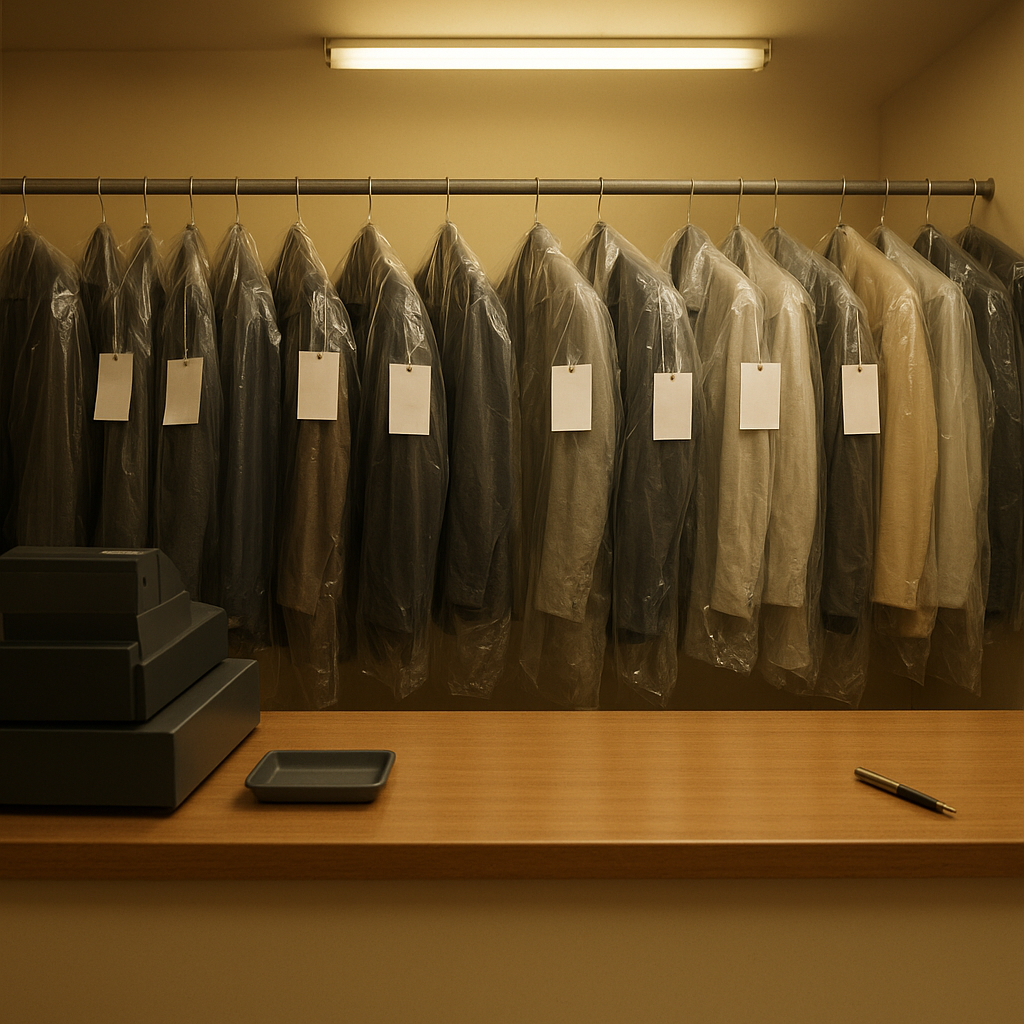
Dry cleaning claim tickets are the small numbered paper tags that link a customer’s garment to their pickup receipt, and the right format stops lost items, double claims, and awkward counter disputes before they start. For a Saudi laundry or dry-cleaning counter handling dozens of bags a day, the ticket is cheap, but a badly chosen one is not.
What Are Dry Cleaning Claim Tickets, and Why Do They Matter?
A claim ticket is a small, pre-numbered tag printed in two or three identical parts: one half stays pinned or looped to the garment, the other goes to the customer as their pickup stub. A dry cleaning claim ticket is, in one sentence, a numbered proof of custody that lets a counter match any garment on the rack to the person who dropped it off, without reading a name or a phone number out loud.
Laundries that still write customer names on masking tape run into the same three problems: handwriting that staff can’t read later, tape that peels off during the dry cleaning cycle itself, and no second copy for the customer to prove they ever dropped anything off. A numbered ticket system fixes all three at once, and it is one of the cheapest loss-prevention tools a laundry counter can buy.
Claim Ticket Formats: Which One Actually Fits Your Counter?
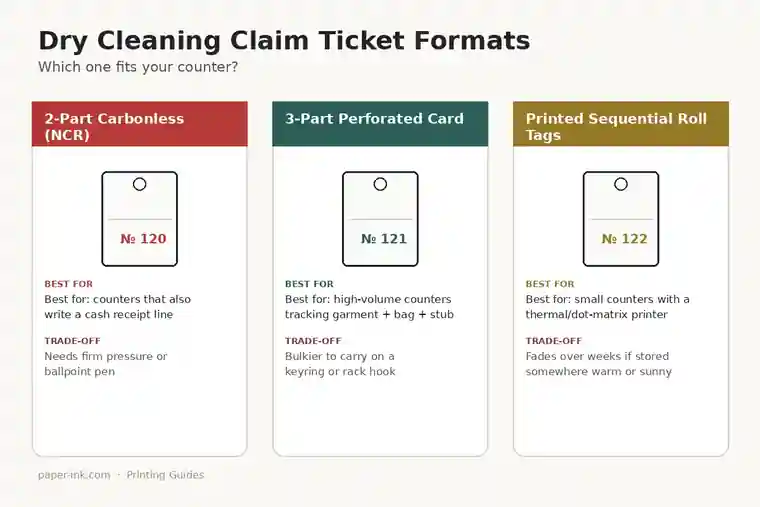
Three formats cover almost every Saudi laundry or dry-cleaning counter. The right one depends on volume, whether you also hand out a cash receipt, and how long an item typically stays on the rack.
| Format | Best for | Trade-off |
|---|---|---|
| 2-part carbonless (NCR) | Counters that also need a written receipt line (item count, price) | Needs firm pressure or a ballpoint, not a soft gel pen |
| 3-part perforated card | High-volume counters tracking garment + bag + customer stub separately | Bulkier to carry on a keyring or rack hook |
| Printed sequential roll tags | Small counters with a thermal or dot-matrix ticket printer | Fades over weeks if stored somewhere warm or sunny |
Whichever format you pick, the numbers should run in one unbroken sequence, not restart at 1 every morning — restarting is the single most common cause of two customers holding the same ticket number on the same day. If your counter also hands out a written receipt alongside the claim ticket, the same carbonless, pre-numbered logic applies there too; our printed invoice booklet guide covers how sequential numbering works on a receipt pad, and the same principle — one number, one unbroken sequence — carries straight over to claim tickets.
How a Numbering System Actually Prevents Lost Garments
A sequential numbering system prevents lost garments because every tag has exactly one match on the rack and one match on the counter — never two. When numbers run continuously across weeks (not reset daily), staff can glance at a gap in the sequence and immediately know an item is missing from the rack, long before a customer calls to ask about it.
Common Mistakes Saudi Laundries Make With Claim Tickets
Reusing the same ticket book across two branches. If two locations share one numbered book, the same number appears twice in one week, and there is no way to tell which branch a stray tag belongs to.
Choosing paper too thin for the cleaning process. A tag that goes through steam or a hot press needs card stock, not standard copy paper — thin paper tears at the string hole within a day or two.
No fixed place to file the customer’s stub copy. Staff hand the stub to the customer but never log which number is open, so an unclaimed item after 30 days is hard to trace back to a phone number.
Printing color-coding as an afterthought. Many counters run same-day, next-day, and dry-clean-only queues at once; a single ticket color for all three makes rack sorting slower, not faster. A matching set of colored packaging stickers on the garment bag itself — one color per queue — lets staff sort from across the room before they even reach the rack.
Treating the ticket as separate from the business’s paperwork. A claim ticket is a loss-prevention tool, not a tax document, but if your counter also prints a same-day cash receipt for the cleaning fee, that receipt still falls under Saudi Arabia’s e-invoicing rules; the ZATCA e-invoicing guidance is the right place to confirm what a compliant receipt needs, separately from the claim ticket’s own numbering.
Checklist Before You Order Claim Tickets
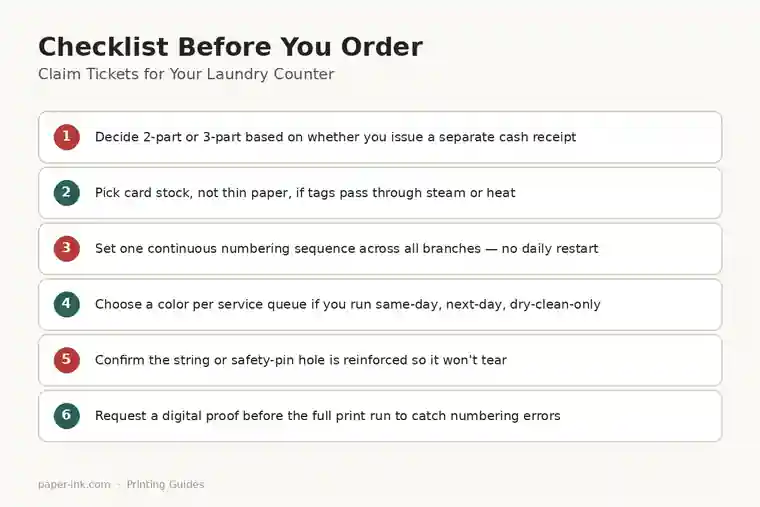
- Decide 2-part or 3-part based on whether you issue a separate cash receipt
- Pick card stock, not thin paper, if tags pass through steam or heat
- Set one continuous numbering sequence across all branches, not a daily restart
- Choose a color per service queue (same-day, next-day, dry-clean-only) if you run more than one
- Confirm the string or safety-pin hole is reinforced so it doesn’t tear during handling
- Request a digital proof before the full print run to catch any numbering error early
FAQ
Do claim tickets need to match the cash receipt number? They don’t have to be the same number, but many counters link them anyway so a single lookup finds both the garment and the payment record — simpler for staff trained on one system.
What size is a standard dry cleaning claim ticket? Most printed tags run small, in the 5×9 cm to 6×10 cm range, since they have to fit through a string hole and sit flat against a garment without flapping loose.
Can claim tickets be reused after a customer picks up their item? No — once a number is issued, it should be retired rather than reused, since reusing a number is exactly what breaks the one-tag-one-match rule the whole system depends on.
How many tickets should a small laundry order at once? Order in a quantity that covers a full numbering block without gaps — splitting one sequence across two separate print orders tends to create duplicate or skipped numbers.
Bringing It Together
In short, a dry cleaning claim ticket only does its job when the numbering never resets, the stock survives steam and handling, and the format matches how the counter actually works day to day — get those three right, and a two-riyal ticket solves a problem that otherwise costs a customer relationship.
Need a numbered ticket or custom tag run sized for your counter? Request a free quote and digital proof, or message Paper-Ink directly on WhatsApp with your counter’s daily ticket volume.
