

Paper Ink Blog
Tailor Shop Printing Essentials: Tags, Receipts & Measurement Cards in Saudi Arabia


A tailor or alterations shop in Saudi Arabia needs four printed essentials to run smoothly: numbered order tags for garments awaiting alterations, a carbon-copy receipt book for customers, fabric and measurement reference cards, and clear in-store pricing signage. None of these cost much on their own, but together they prevent the most common and most expensive mistake in a tailoring shop: handing a customer the wrong altered garment, or losing track of which piece belongs to which order.
Why does a tailor shop need numbered garment tags?
A numbered garment tag is a small, durable label pinned or tied to a piece of clothing the moment it is dropped off, linking that specific item to one customer’s order until it is collected. In a one- or two-person alterations shop, a handful of similar-looking trousers or thobes waiting for the same hemming job are easy to mix up. A tag with a sequential number, matched to a duplicate slip the customer keeps, removes the guesswork before it becomes a dispute at pickup.
Saudi business-setup guidance for small retail and service outlets, including tailoring and dressmaking shops, consistently points to having a clear intake-and-handover system as part of standard shop operations — numbered tags are the simplest way to put that requirement into daily practice rather than leaving it to memory.

Paper tag or sewn-in label?
A hang tag attached with string works for most alteration jobs that take a day or two. For garments that stay longer — a full suit relining, for example — a small sewn-in fabric label with the order number is more reliable, since string tags can be cut off accidentally during fitting. Shops that want several tag sizes or shapes to test can compare material options in Paper-Ink’s sticker printing category.
What should a tailor shop’s receipt book actually include?
A carbon-copy receipt book gives both the tailor and the customer an identical written record of the work agreed on, the price, and the promised pickup date, which prevents disagreements when the customer returns. The most useful format is a pre-numbered, two-part pad (original plus carbon copy) capturing: customer name and phone number, the exact alteration requested per item, number of pieces, agreed price, and expected completion date.
A point-of-sale app can log the same information, but a paper copy handed over on the spot still matters in a small shop during busy hours or whenever the internet connection drops — it is the one record that never depends on a device working.
Why do measurement reference cards save repeat visits?
A printed measurement card stores a regular customer’s key body measurements on file, so a returning customer for a new order doesn’t need a full re-measurement every single visit. For a tailoring shop built on repeat customers — uniforms, thobes, suits — this single card can cut several minutes off every repeat order and reduces measurement errors caused by rushing.
These cards work best filed by customer name in a simple box or binder at the counter, with the date of the last measurement noted so the tailor knows when it may be worth re-checking, since body measurements do change over time. A durable card stock matters here too — the same category of material used for receipt pads and tags, browsable in Paper-Ink’s business stationery category.
| Printed item | Main purpose | Suggested material |
|---|---|---|
| Numbered garment tag | Track one item from drop-off to pickup | Durable tag or sewn-in label |
| Carbon-copy receipt book | Record price and agreed alteration | Pre-numbered duplicate pad |
| Measurement reference card | Speed up repeat customer orders | Card stock, filed by name |
| Pricing signage | Answer common pricing questions upfront | Rigid board or laminated sheet |
| Delivery bag sticker | Brand the finished garment on pickup | Glossy or matte packaging sticker |
Does in-store pricing signage really reduce interruptions?
Clear pricing signage at the counter answers the most repeated customer question — “how much for a hem, how much for a zipper” — before it is even asked, letting the tailor keep working instead of stopping for every price inquiry. A simple board listing common jobs (hemming, taking in a waist, zipper replacement, thobe sleeve shortening) with a price range, rather than one fixed number for every fabric and garment type, keeps the sign accurate without needing constant reprinting. A matching sticker on the finished-garment delivery bag, from the same packaging stickers category, finishes the hand-off with a consistent look.
What printing mistakes do alteration shops make most often?
Using plain paper tags instead of a tear-resistant or sewn-in option: a paper tag pinned to fabric tears off during fitting, and the order number disappears with it.
Skipping sequential numbering on receipts: without a running number, there is no quick way to confirm which of several similar orders belongs to which customer during a busy afternoon.
No visible pricing near the counter: every customer ends up asking the same questions out loud, slowing down every other transaction in the shop.
Printing the shop’s delivery bag or label at low resolution: a blurry logo on the finished garment’s bag undercuts the quality of the alteration work itself.
Checklist before you print your tailor shop’s essentials
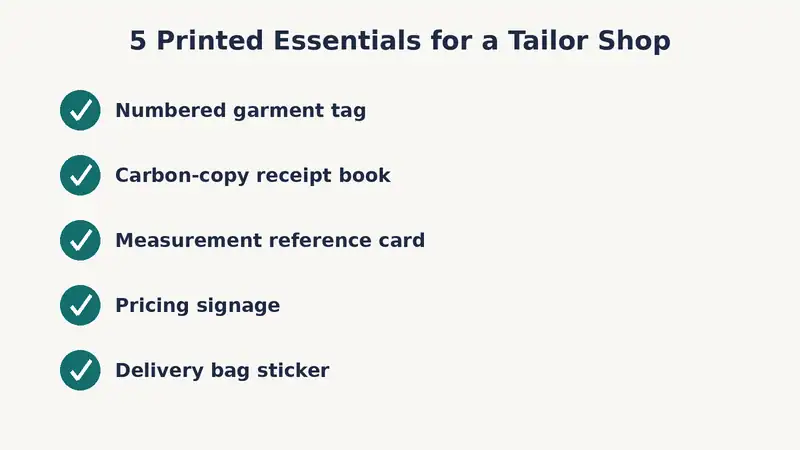
- Numbered garment tags (or sewn-in labels for multi-day jobs)
- Pre-numbered, two-part carbon-copy receipt book
- Measurement reference cards filed by returning customer
- Pricing signage listing common alteration jobs and ranges
- A consistent sticker or label for finished-garment delivery bags
- A free digital proof reviewed before the full print run
Frequently asked questions about tailor shop printing
Do I need a municipal license to open a tailoring shop in Saudi Arabia?
Yes — opening a tailoring or alterations shop in Saudi Arabia requires a commercial registration and a municipal license, with requirements that can vary by city and shop size, similar to other small retail and service businesses.
How do I stop customer garments from getting mixed up?
Attach a numbered tag or sewn-in label to every item the moment it arrives, and give the customer a matching numbered receipt, so any piece can be traced back to its order even if it is separated from the rest during fitting or pressing.
What’s the difference between a garment tag and a receipt?
The tag stays physically attached to the fabric throughout the alteration process, while the receipt is the paper record the customer keeps — both should share the same order number so they can always be matched.
Are regular packaging stickers suitable for tailor shop delivery bags?
Packaging stickers designed to hold on fabric bags and resist light handling work well; very thin paper labels tend to peel off quickly once a folded garment is handled a few times.
Bringing it together
Garment tags, a numbered receipt book, measurement cards, and clear pricing signage are a small, one-time print investment that protects the thing a tailoring shop actually sells: the certainty that the right garment comes back to the right customer, altered exactly as agreed. For more on the trade itself, see this overview of the tailoring profession. Message Paper-Ink on WhatsApp or request a quote for a free digital proof of your shop’s tags, receipts, and signage before anything goes to print.
