

Paper Ink Blog
Employee Handbook & Training Manual Printing: A Practical Guide for Saudi Small Businesses

The best way to print an employee handbook or new-hire training manual is to match the binding and paper stock to how often staff will actually flip through it, then order one proof copy before the full print run. That single decision affects both the final durability of the booklet and your total cost, and it saves you from reprinting an entire batch if a policy or page order needs a last-minute fix after approval.
Every growing Saudi business reaches the same point: new hires keep arriving, and the same onboarding questions keep landing on the same manager’s desk. A clear printed booklet handed to every new employee on day one solves most of that repetition.
An employee handbook is a printed or digital booklet that explains a company’s policies, employee rights and expected conduct, while a training manual focuses on the practical steps a new hire follows during onboarding. Both are usually printed with a sturdy paper cover and saddle-stitch or spiral binding so they survive daily handling without falling apart.
What’s the Difference Between an Employee Handbook and a Training Manual?
An employee handbook is a reference document employees keep for as long as they work at the company — attendance and leave policies, codes of conduct, and the rights and obligations of both sides. Staff come back to it occasionally throughout their employment, so it needs binding that survives years of intermittent flipping, as described in the Employee handbook overview on Wikipedia.
A training manual, by contrast, is a short-term tool: it travels with the employee for the first two to four weeks only, and focuses on practical steps — how to clock in, who to contact for common questions, and what tasks are expected in week one. Many small businesses combine both into a single booklet to save on printing, which works fine as long as the internal structure keeps the two sections clearly separated, following the same logic covered in this general training manual reference.
Section takeaway: an employee handbook is a near-permanent policy document, while a training manual is a short-term onboarding tool, and merging them into one booklet only works if the two sections stay clearly separated.
Is a Printed Internal Work Regulation Required for Businesses in Saudi Arabia?
A number of private-sector establishments in Saudi Arabia are required to prepare an internal work regulation that sets out the rights and obligations of both employer and employee, under criteria set by the Ministry of Human Resources and Social Development (MHRSD) according to each establishment’s classification. The exact applicability and the type of action required for your specific business should be confirmed directly through the Ministry’s own channel, not guessed from a general guide.
Regardless of the precise legal threshold for your establishment, many fast-growing Saudi SMEs choose to prepare a printed internal policy booklet early anyway, simply to standardize the onboarding experience and cut down on the same questions being asked individually by every new hire.
Section takeaway: confirming the exact legal requirement for an internal work regulation depends on your establishment’s classification with the Ministry, but preparing a printed internal booklet is practically useful for any fast-growing business regardless of that classification.
What Should a New-Hire Training Manual Actually Include?
A good training manual does not need to be long, but it does need to cover everything a new hire needs in week one without having to ask verbally:
- A short overview of the company and the employee’s immediate team.
- Attendance, leave and basic conduct policies.
- A numbered, step-by-step walkthrough of day one and week one.
- Internal contacts for each department or common question.
- Workplace safety guidelines, where relevant to the role.
Many small businesses pair this booklet with a simple, practical day-one item, such as the ideas covered in this branded corporate notebook and planner gift guide, to round out the onboarding experience without much added cost. It is also worth comparing this printed approach against a broader corporate onboarding welcome kit if you want the handbook to be just one piece of a larger first-day package.
Section takeaway: an effective training manual covers five core elements only — company overview, attendance policy, week-one steps, internal contacts, and safety guidelines where relevant.
Which Binding and Paper Options Hold Up to Daily Use?
The right binding depends on page count and how often an employee re-opens the booklet, not just on appearance:
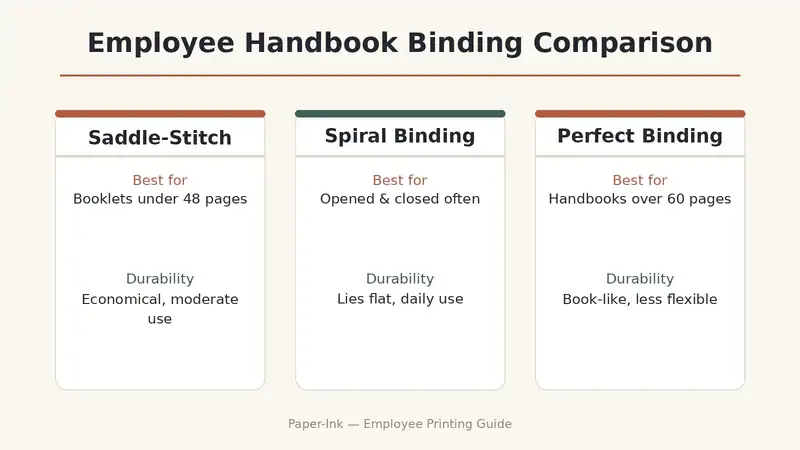
| Binding Type | Best For | Durability Note |
|---|---|---|
| Saddle-stitch | Booklets under 48 pages | Economical, but holds up to moderate flipping only |
| Spiral binding | Booklets opened and closed often | Lies fully flat, handles intensive daily use |
| Perfect binding | Handbooks over 60 pages | Looks closer to a commercial book, less flexible to lay flat |
If your handbook runs under 48 pages, simple saddle-stitch binding is usually enough. In either case, ordering one proof copy before the full run catches layout or color issues early, before they repeat across every printed copy.
Section takeaway: spiral binding is the best fit for a booklet that gets opened flat every day, while saddle-stitch is sufficient for shorter, lower-use booklets.
What Are the Most Common Mistakes When Printing an Employee Handbook?
- Skipping the proof copy: printing the full quantity straight away means any layout error repeats across every single copy.
- Choosing binding that can’t handle daily use: saddle-stitch on a booklet opened and closed daily tends to fall apart within a few weeks.
- Overloading the booklet with unnecessary detail: an overly long handbook makes employees less likely to actually reference it when needed.
- Not reprinting after policy updates: handing out outdated copies creates real confusion between employees working from different versions.
- Printing the full quantity before final management sign-off: any late content change then means reprinting the entire batch.
Checklist Before Printing Your Employee Handbook or Training Manual
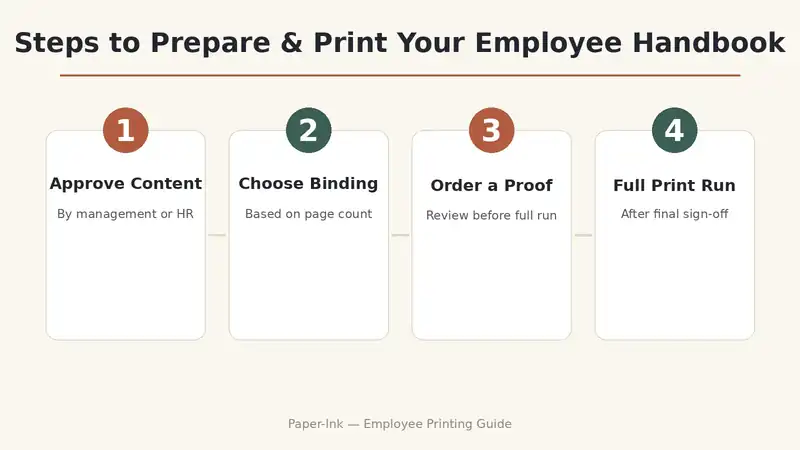
- Final content approved by management or HR.
- Decided whether you need a policy handbook, a training manual, or both combined in one booklet.
- Binding type selected based on page count and daily-use frequency.
- File prepared as a 300 DPI, CMYK-ready PDF.
- One proof copy ordered before the full print run.
- Prepared custom to-do-list notepads for new hires to use during the first training sessions.
Frequently Asked Questions About Employee Handbook and Training Manual Printing
Is an internal work regulation (official employee handbook) mandatory for every business in Saudi Arabia?
Applicability depends on your establishment’s classification under Ministry of Human Resources and Social Development criteria, and confirming your specific case should go through the Ministry’s own official channel referenced above.
What’s the practical difference between an employee handbook and a new-hire training manual?
An employee handbook is a near-permanent policy reference employees use throughout their employment, while a training manual is a short-term tool covering only the first few weeks after joining.
How many copies of an employee handbook should we print initially?
Order one proof copy to check layout and color first, then print enough copies to cover current staff plus a small margin for hiring planned over the next few months.
What’s the best binding for a handbook employees open every day?
Spiral binding is generally the best fit because it lies fully flat and holds up to frequent daily opening and closing far better than simple saddle-stitch binding.
Conclusion
Printing an employee handbook or training manual is as much a production decision as a content one — the right binding and a proof copy protect you from a full reprint, and confirming the exact legal requirement needs a direct check with the Ministry rather than a guess. You can also browse the rest of Paper-Ink’s business stationery printing if your business needs other printed materials. Request a quote from Paper-Ink to print your employee handbook in the option that actually fits your company’s size.
